What to Order in a Greek Taverna - a guide for first-timers
How ordering works in a Greek taverna, what mezedes are, how fish and wine are charged, and a short guide to the dishes, with tipping and berthing in the harbour.
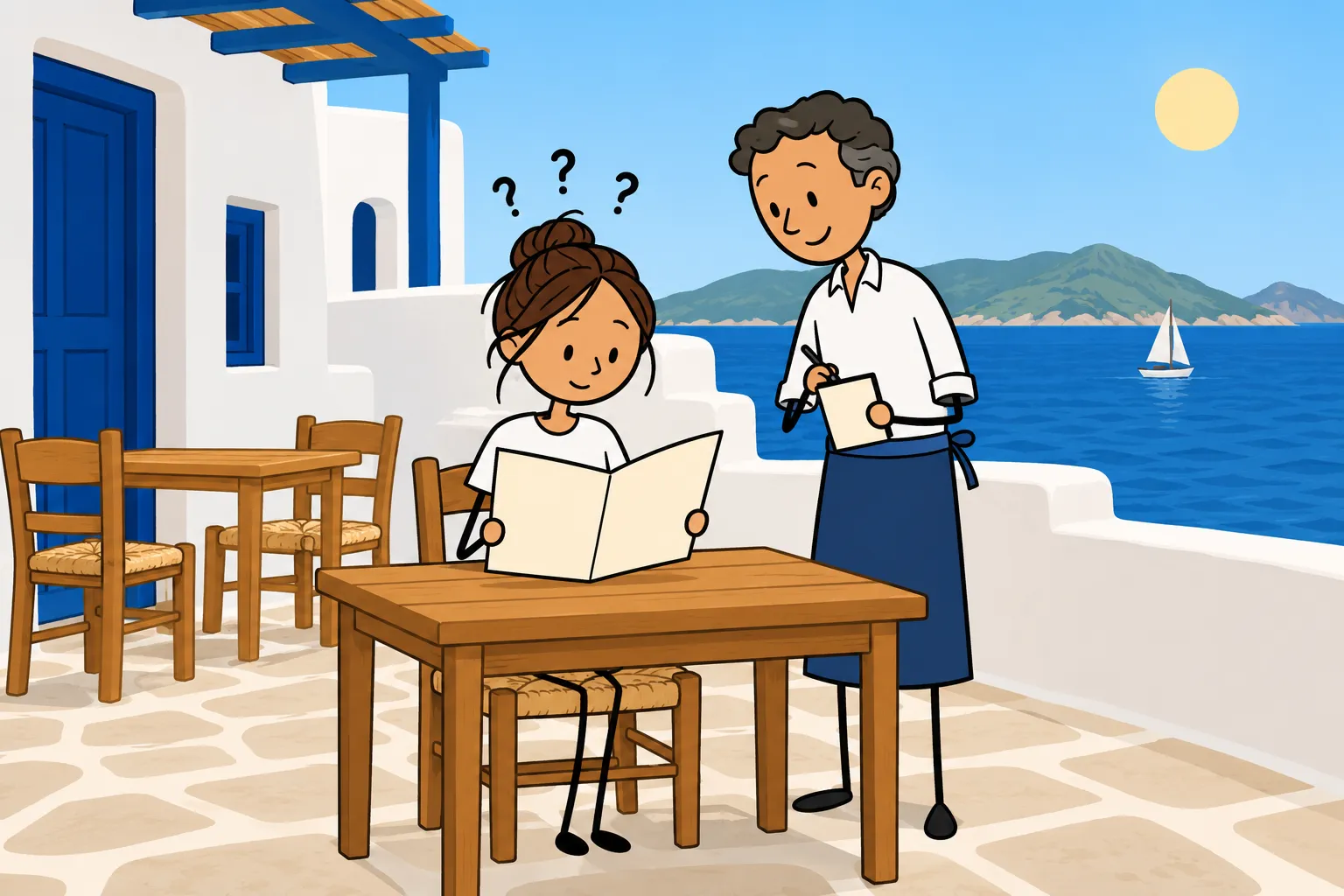
After a day at sea, dinner in a taverna is for many people the best part of a week of sailing in Greece: a table right on the quay, the boat tied up a few metres away, and food nobody rushes. The menu can be confusing, with unfamiliar names and no obvious order, but it gets easy once you know how Greeks eat.
The short version: you order for the whole table rather than for yourself, dishes arrive as they are ready, fish is priced by the kilo, and wine often comes by the carafe. Everything else is below, with each dish explained.
How does ordering in a taverna work?
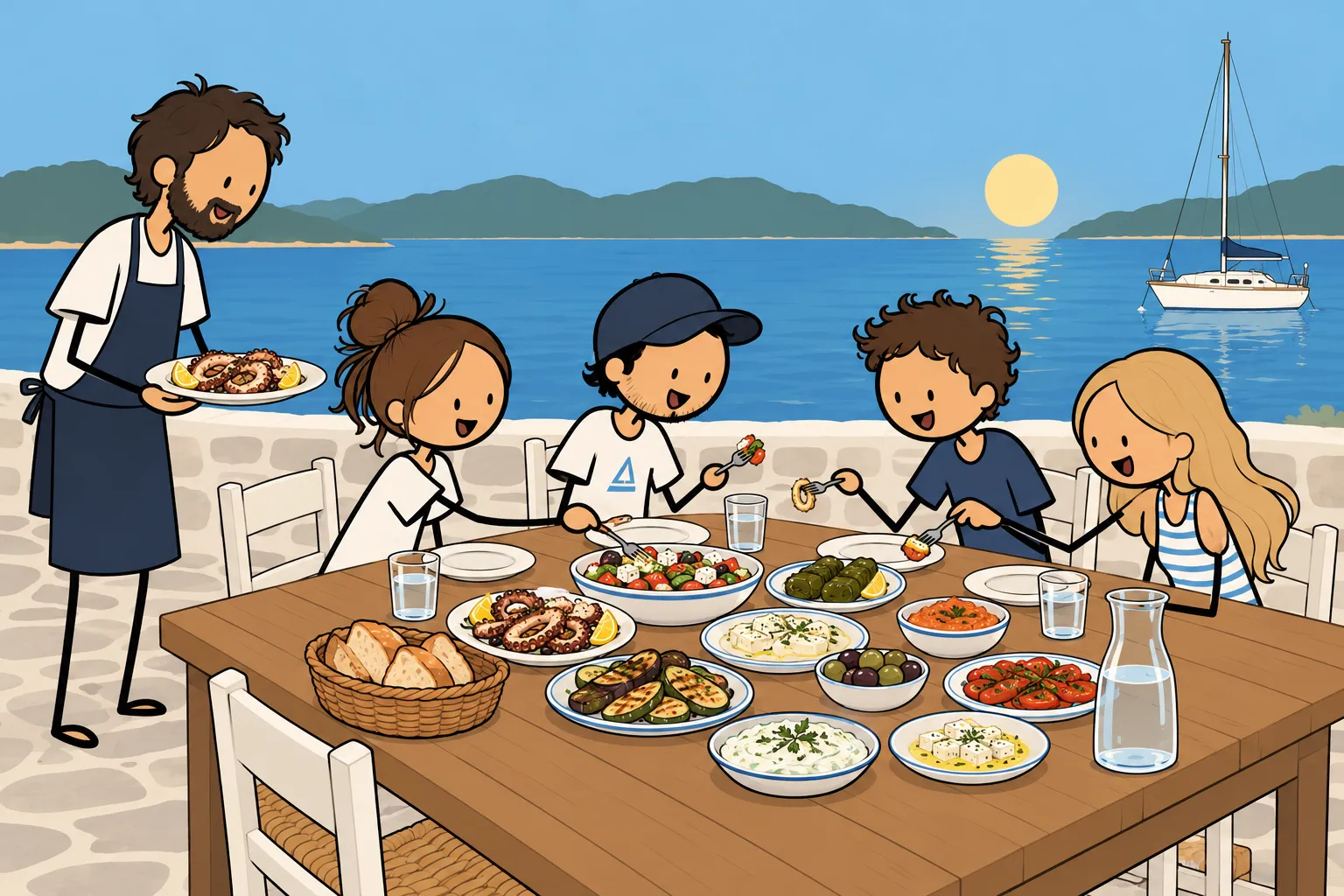
A Greek meal is shared. Instead of one plate per person, several dishes land in the middle of the table and everyone helps themselves. It pays to order several different things rather than several of the same.
- Start with mezedes. These are small plates (salads, dips, fried vegetables, cheese, octopus) eaten with drinks and bread. Two or three per person is a good start, and you add more as you go.
- Dishes don't arrive in courses. The kitchen sends whatever is ready, so a main can turn up in the middle of the starters. That is normal.
- Bread and the cover charge. Bread often arrives without being asked for, and many tavernas charge a small amount per person for it (the "cover"). It is standard, not a trick.
- Ask the waiter. "What do you recommend today?" is a perfectly normal question. The best dish is often not on the menu, because it depends on what came in that morning.
- Nobody hurries you. The bill only arrives when you ask for it ("to logariasmo, parakalo").
Which salads, dips and mezedes should you order?
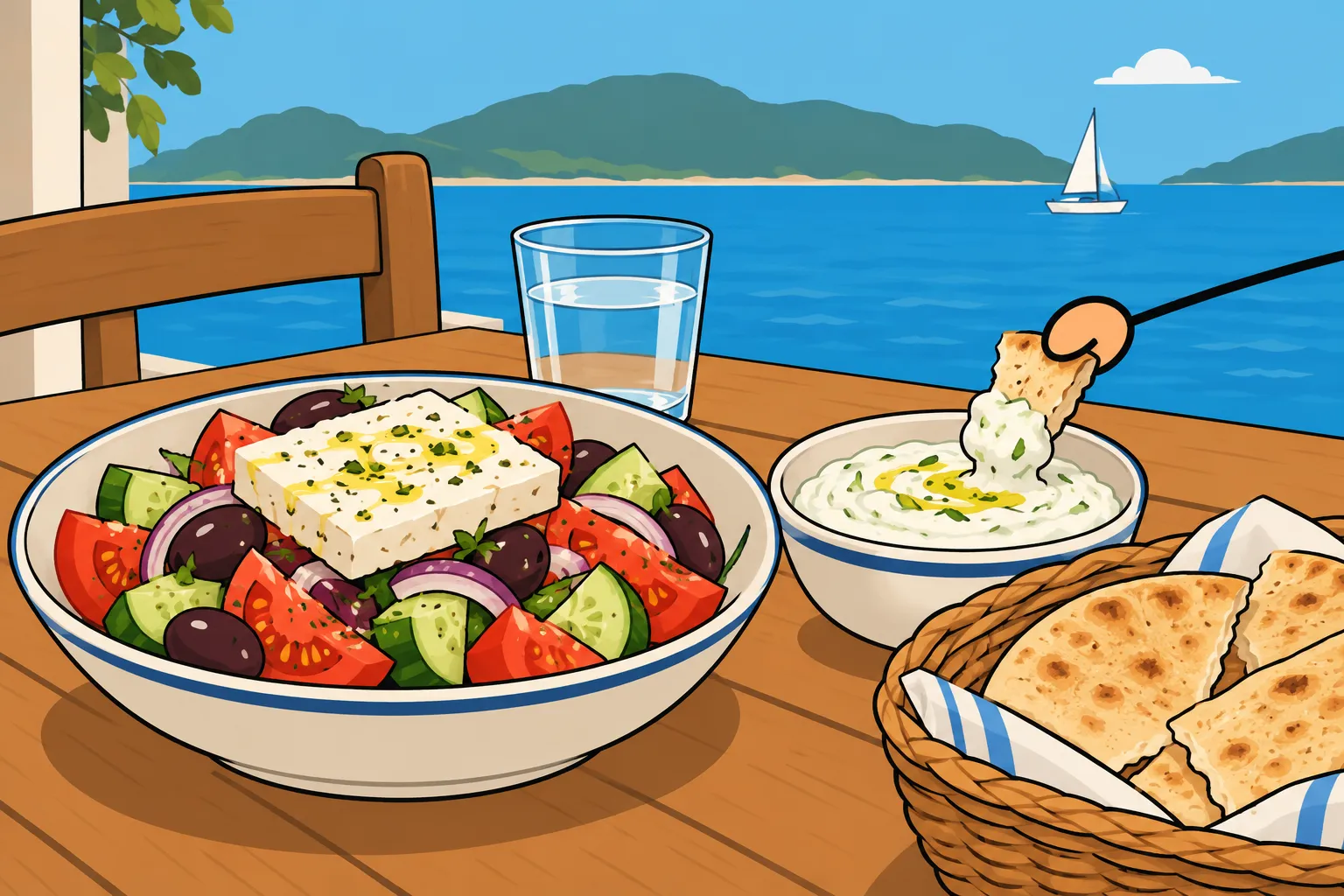
Mezedes are the real reason to go to a taverna. The first round is light and hard to get wrong.
Salads and dips
- Horiatiki - what we call Greek salad: tomato, cucumber, onion, olives and a thick slab of feta with olive oil. No lettuce.
- Tzatziki - a dip of yoghurt, cucumber and garlic. Excellent with bread and with anything fried.
- Melitzanosalata - a smoky dip of roasted aubergine with garlic and oil.
- Taramosalata - a smooth, salty cream of fish roe, eaten with bread.
- Fava - a soft purée of yellow split peas, often with capers or onion.
Mezedes
If you don't know what to pick, these are reliable.
- Saganaki - fried cheese, crisp outside and soft inside, served hot with lemon.
- Kolokithokeftedes - courgette fritters, served with tzatziki.
- Tiropita and spanakopita - cheese or spinach pie in thin pastry. Some islands have their own local versions, so try one wherever you see it.
- Gigantes - big white beans baked in tomato sauce.
- Htapodi - octopus, usually grilled, with olive oil and lemon.
- Kalamarakia - fried baby squid, crisp and served with lemon.
What do you order as a main course?
After the mezedes the main is often just an extra, since the table is already full. These are the classics.
- Souvlaki - skewers of grilled pork or chicken, on a plate with chips or wrapped in pita.
- Gyros - thinly sliced meat from a vertical spit, with tzatziki and chips.
- Moussaka - layers of aubergine, minced meat and a creamy sauce, baked in the oven.
- Stifado - slow-cooked beef or rabbit with plenty of onion in a thick sauce.
- Kleftiko - lamb roasted slowly until it falls off the bone.
How do fish and seafood work?
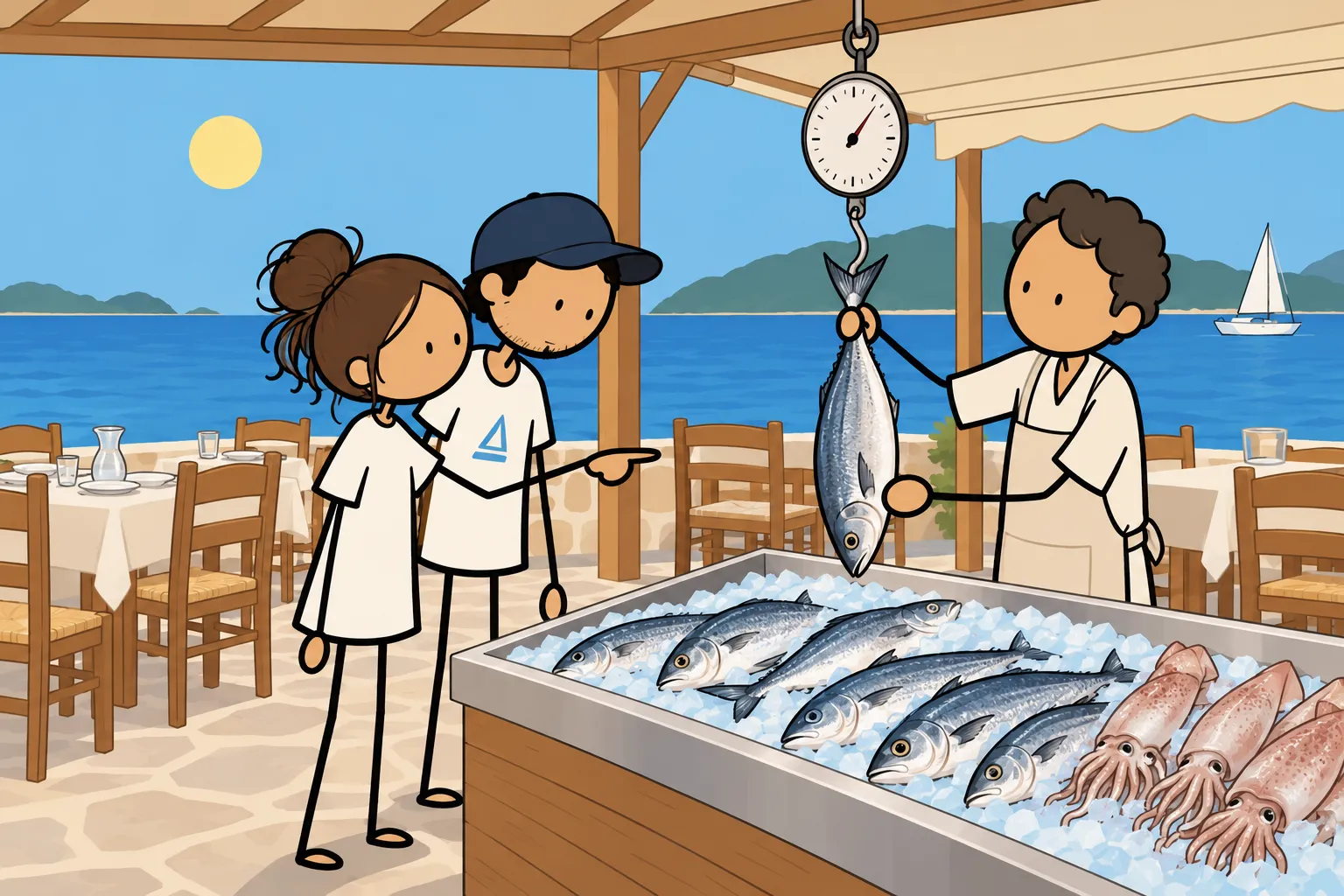
This is the part visitors most often don't expect, and it isn't complicated.
In most tavernas fish is sold by the kilo, and the price on the menu is the price per kilo, not per portion. The waiter usually takes you to the fridge or counter, shows you the fish, weighs it before it is cooked and tells you the price. Only then do you decide. If the price isn't clear, ask before the fish goes on the grill.
- Choose with your eyes: clear eyes, shiny skin, firm flesh.
- One larger fish is usually enough for two or three people, with a salad and potatoes.
- It is most often grilled or cooked in a soup, with olive oil and lemon.
- Small seafood (squid, gavros) is usually sold by the portion, not by the kilo.
- Lobster and prawns go by weight and cost much more, so ask the price first.
If you can't decide, ask what the catch of the day is.
Which desserts and drinks should you try?
At the end of the meal many tavernas bring something on the house, such as fruit or a small sweet. If they don't, order one of these.
- Galaktoboureko - semolina custard in layers of pastry, soaked in syrup.
- Baklava - layers of pastry with walnuts and honey.
- Greek yoghurt with honey - the simplest and often the best.
- Loukoumades - little fried dough balls drizzled with honey.
Drinks are often ordered by measure. House wine usually comes by the kilo or in a carafe (half a litre, a litre), and it is typically good and inexpensive. Ask for "krasi" and say white (lefko), red (kokkino) or rosé. Retsina is white wine with pine resin: you either love it or you don't. Ouzo, diluted with water and ice, is a common companion to mezedes.
What if the taverna has its own jetty?
On some islands tavernas have their own jetty or pontoon on the quay. You tie up there, and the berth is often free if you dine at that taverna. Some also provide lines and showers, and expect you to sit at their tables. The rule isn't the same everywhere, so ask in advance, and sometimes you can book before you arrive.
For more on where you spend the night, see marinas, quays and anchorages.
Do you have to tip?
Tipping is customary but not mandatory. People usually round the bill up or leave a little extra, in cash on the table. If the service was excellent you can leave more, and if it wasn't, it is fine to leave less. Check the bill first: the cover charge is already on it.
How does this fit into a week of sailing?
On the Ionian and elsewhere, a typical day looks like this: breakfast on the boat or in the marina, sailing to the next cove or island, a swim and lunch, and dinner in a taverna on the island or on board. Food and drinks aren't included in the boat price, so dinners are paid separately. What you cook on board is a topic of its own.
Frequently asked questions
1What should I order in a Greek taverna for the first time?
2How many dishes should we order for the table?
3Why is fish priced by the kilo?
4Is tipping obligatory?
5Is the house wine any good?
Your week
Ready for dinners by the sea?
If you would like these dinners to be part of your trip, we will help you choose a boat and a route.