Marina, Town Quay or Anchorage - where does the boat stay overnight?
The difference between a marina, a town quay and an anchorage: what each offers (water, power, showers, quiet), what stern-to mooring looks like and who picks the place for the night.
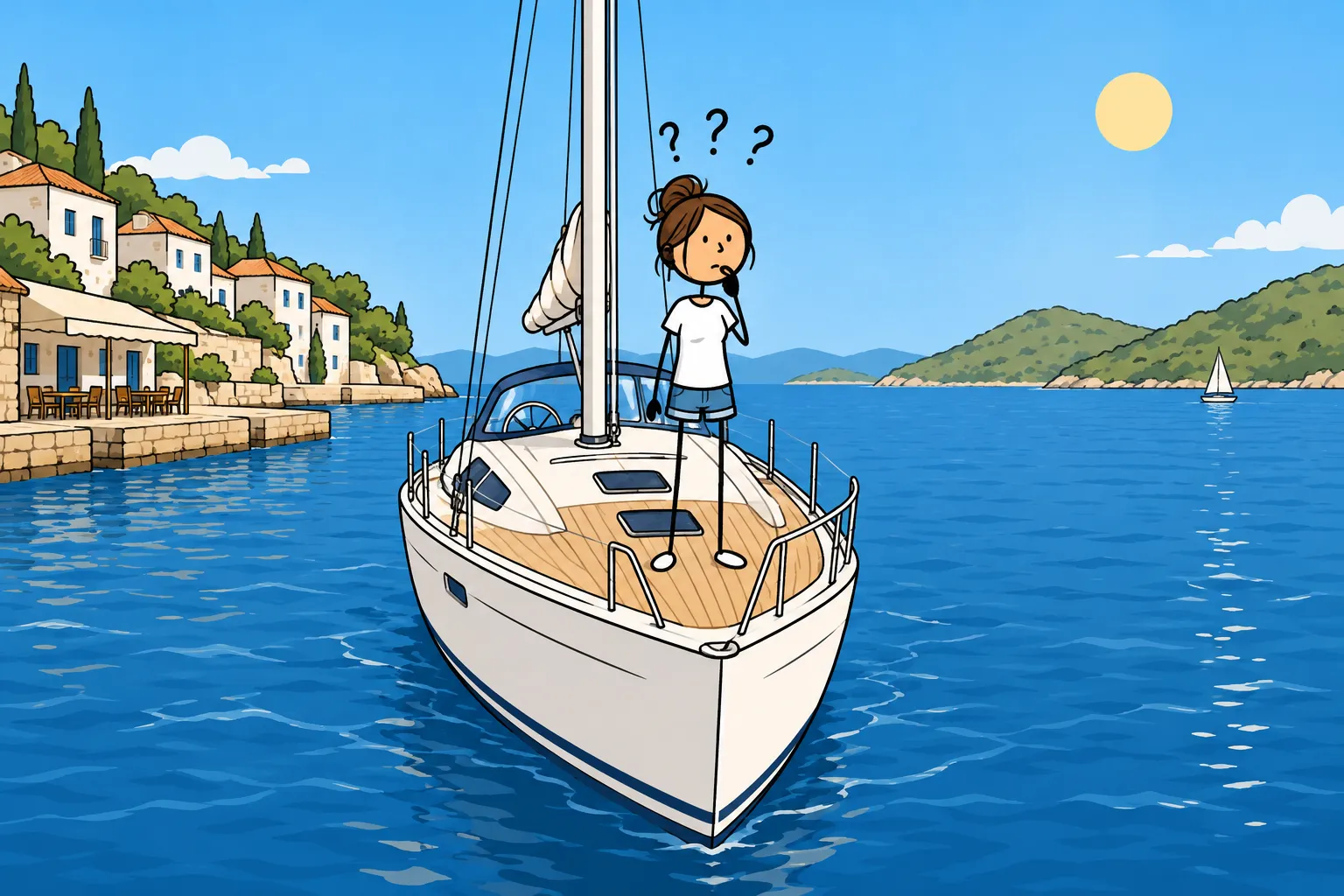
On a week under sail the boat spends each night in a different place, and where depends on the wind, the crew and what you feel like that evening: a shower and dinner at a taverna, or silence in a bay. Greece offers three basic choices: a marina, a town quay and an anchorage. Each has its own advantages, so it helps to know them in advance.
In Greece, for example in the Saronic Gulf, you usually combine all three. The skipper picks the place for the night, and this page explains what each option means for you.
What is the difference between a marina, a quay and an anchorage?
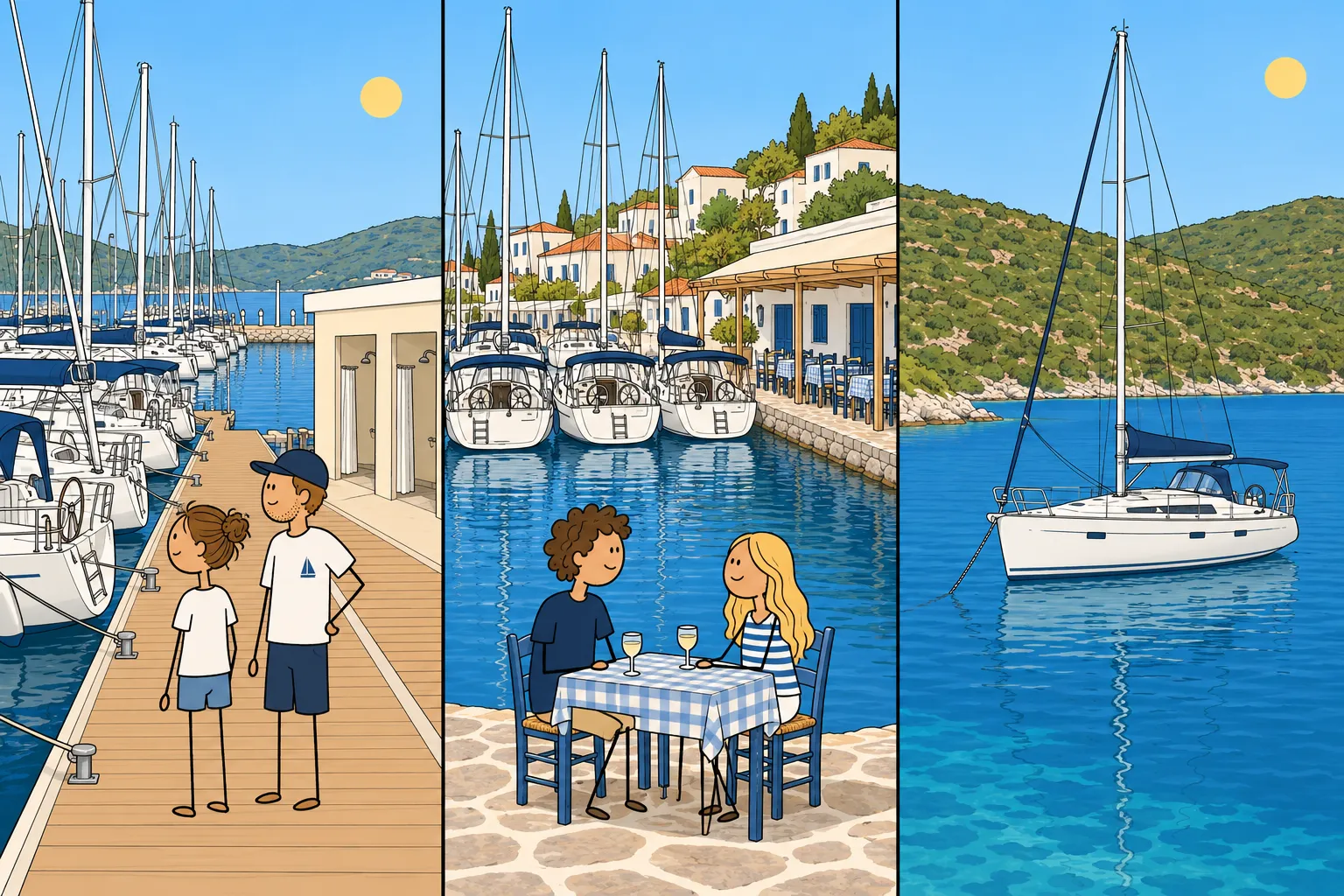
In short: in a marina you pay for comfort, at a town quay you pay little (or nothing) for the life of the town, and at anchor you get quiet.
- Water and power. Marina: usually yes, sometimes extra. Town quay: sometimes, shared hook-ups. Anchorage: no.
- Showers and toilets. Marina: yes. Town quay: rarely, often at a nearby cafe or hotel. Anchorage: no.
- Quiet. Marina: fairly calm. Town quay: ferries, engines, nightlife. Anchorage: quietest.
- Cost. Marina: highest. Town quay: lower, sometimes free. Anchorage: free.
- Shops and restaurants. Marina: often close by. Town quay: right beside the boat. Anchorage: only if you dinghy ashore.
What does a marina offer?
A marina is a purpose-built harbour with pontoons, often with water, power, showers and toilets, and frequently a shop, a restaurant and security. Boats are tied up in rows, safely and sheltered from waves.
- Advantages. A shower and a water refill are at hand, and the boat sits in a protected space. After a few days at sea, a long shower is welcome.
- Drawbacks. It is the most expensive option and usually has less character than a town quay. In season you need to arrive early to find a berth.
- With us. The boat spends the last night of the week in the base marina, because it returns on Friday by 18:00 and check-out is on Saturday by 09:00.
Marina and port fees are not included in the boat price, so the crew pays them during the week.
What is a town quay like?
A town quay is a stone or concrete edge along the waterfront, and most Greek harbours are like that. Boats lie side by side, stern to the quay, and right behind the quay are tavernas, cafes and shops.
- Advantages. You step off the boat straight into town, dinner is a few paces away and the harbour is full of life.
- Drawbacks. Water and power are not always available, and where they are, they are often shared with fishermen or paid for. Quays next to the ferry are noisy, and the wash from a ferry can rock the boat.
- Cost. The harbour fee depends on the harbour, the season and the length of the boat: in places it is free, in others it is charged per metre. It is usually collected late in the afternoon.
- Space. In July and August quays fill up early, so it pays to arrive early, as a rule before 15:00.
What is stern-to mooring, and who helps with the lines?

Mediterranean mooring, or stern-to mooring, is how boats tie up at a quay in Greece. Instead of coming alongside, the boat turns and reverses towards the quay stern first, while an anchor goes down from the bow.
- 1. The skipper approaches the quay and turns the boat to go astern.
- 2. The anchor is lowered at the bow, and the chain is let out as the boat reverses towards the quay.
- 3. When the boat is close, lines from the stern are tied to cleats or bollards on the quay.
- 4. The anchor chain is tightened, and the boat sits at a right angle to the quay.
Why do it this way? The anchor chain cushions waves and wind, the boat stays clear of the quay, and neighbours do not walk across your deck. Leaving is also easier than from a tightly packed row.
In some harbours guests help with the lines: passing or throwing a line, tying it to a cleat, putting out the fenders. It is basic, it needs no prior knowledge, and the skipper explains it at the start of every week.
What are taverna jetties?
Some tavernas have their own jetty or a section of quay, and give diners a free berth. It is a pleasant perk: the boat sits right by the tables, and you eat with no transport needed.
Before you tie up, ask on what terms. In some places you are expected to eat at the taverna, while at others, where the quay is municipal, you are not obliged to even if you are told so.
What is a night at anchor like?

An anchorage is a bay where the boat stays on its anchor, and you reach the shore by dinghy or by swimming. There is no power, water or bins, but there is quiet and swimming straight off the boat.
- Water and power. The water tanks are limited, so life on board means watching how much you use. Power comes from the boat's battery, or a generator on some boats, which is charged per hour in places.
- Quiet. With no ferries or music, a bay at night usually sounds like nothing at all.
- Seabed. The skipper looks for a sandy bottom where the anchor holds well, not Posidonia seagrass, which an anchor damages.
- Space. Whoever arrives first in an anchorage has priority: later boats choose a spot where they do not interfere with those already there.
Who decides where the boat spends the night?
The skipper, who is responsible for the boat and knows the waters. They pick a spot sheltered from the wind, and the route is proposed by the skipper and put together around the weather and the guests' wishes. If you have a wish, say so: dinner at a taverna or a quiet bay, and the skipper will fit it in if the weather allows.
Frequently asked questions
1Where does the boat most often tie up in Greece?
2Do you pay to stay at a quay?
3Can I take a shower at a quay?
4Is a night at anchor safe?
5Do I have to help with the lines?
Your week
Tell us what kind of nights you prefer
Tell us whether you would rather have a shower and dinner in the harbour or a quiet bay.