Sailing week day by day - what really happens from Saturday to Saturday
How a sailing week in Greece really goes: Saturday check-in, the skipper's briefing, food shopping, a typical day at sea and the last night in the marina.

What do you actually do for a whole week on a boat? It's one of the first things people ask when they're thinking about a sailing week in Greece, and it's a fair question. If you've never sailed, it's hard to picture.
The short answer: you swim, eat well, sail a little most days and wake up somewhere new most mornings. There's no fixed timetable and nobody rushing you from island to island. Here's how a week with us goes, from Saturday check-in to Saturday check-out.
How does a sailing week work?
Every week runs from Saturday to Saturday. Only the start and the end are fixed. Everything in between is planned as you go.
- Saturday from 17:00: check-in at the base marina. You move onto the boat and meet your skipper.
- Saturday to Friday: the sailing days. The skipper proposes the route day by day, around the weather and your wishes.
- Friday by 18:00: back in the base marina, where you spend the last night.
- Saturday by 09:00: check-out.
If one week isn't enough, there's also a two-week option.
What happens on Saturday, the first evening?
Check-in starts at 17:00 in the base marina. Bed linen and towels are covered by the yacht package, the separate line you'll see in your offer, so there's nothing to bring for the beds.

Cabins are usually shared by two people, with a double bed or two separate beds, and your group decides who sleeps where. Unpack straight into the lockers: a soft bag folds away, a hard suitcase doesn't fit anywhere.
Then you meet the skipper, who lives on board with you for the whole week. The evening starts with a short briefing on the basics of life on board:
- The toilet: nothing goes in that you haven't eaten first. Toilet paper goes in the bin next to it.
- Water: the tanks hold a few hundred litres and get topped up in a harbour every day or two, so showers are quick.
- The galley: how the stove and oven work, and what's already on board.
- Safety: where the life jackets are and how to move around the deck while sailing.
- Mooring in harbour: how to help with the lines and fenders when the boat ties up. Simple jobs that need no prior knowledge.
The briefing is also where the first conversation about the route happens: what your group wants from the week, which islands you've heard about, and what the forecast says. Nothing gets locked in for the whole week that night.
If everything is ready, the boat sets sail already on Saturday after check-in, which is why an early check-in is worth it. Otherwise the evening is for settling in and sailing starts in the morning. Dinner that first night can be in a taverna near the marina or something simple on board.
When do we shop for food and drinks?
Food and drinks for the crew aren't included in the boat price, so one of the first jobs is the big shop, on Saturday evening or before you leave. We give you shopping lists for the first shop.

- What to buy: the boat has a galley with a stove and an oven. Meals on board are mostly pasta, risotto and other simple cooked dishes, plus breakfast and lunch at anchor.
- How much: enough for the first couple of days, and plenty of bottled water for drinking. Tank water is for showers and washing up.
- Along the way: you top up in island shops, bakeries and markets. Smaller villages have less choice, so keep a day or two of basics on board in case you decide to stay in a quiet bay.
- The skipper eats with you: the crew provides the skipper's food and drinks, and the rule is simple: what you eat, the skipper eats.
If you plan to have dinner in tavernas most evenings, shop lighter. That's part of the fun too.
What does a typical day on board look like?
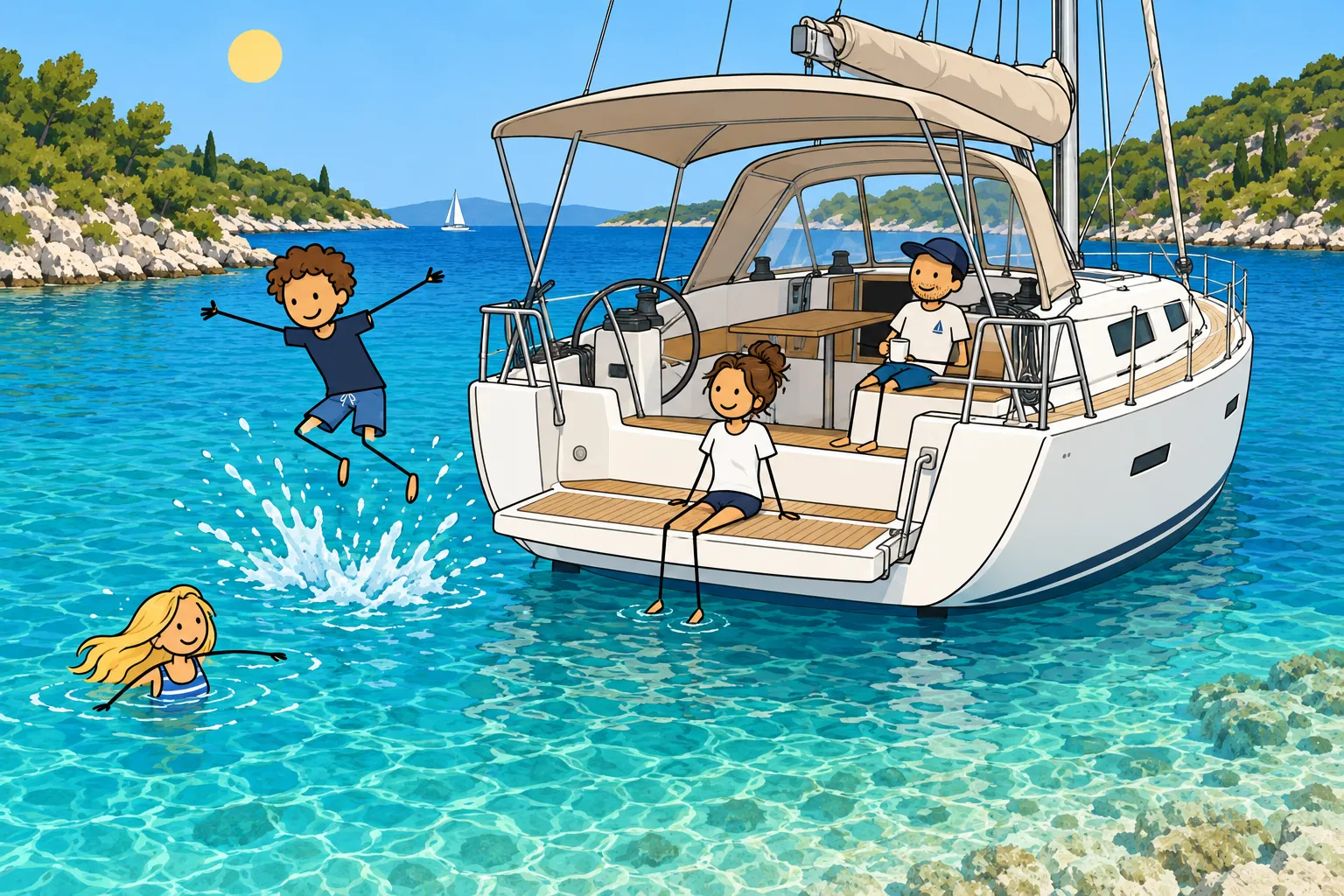
Until Friday, most days follow the same easy rhythm: breakfast, a sail to the next cove or island, swimming and lunch, more sailing in the afternoon, and dinner ashore or on board. Here's what that looks like in practice.
Morning: breakfast and a first swim
Breakfast on the boat or at a café in the marina. If you spent the night at anchor, the first swim often comes before coffee. The skipper checks the forecast and proposes where the day goes, with what you'd like to see in mind.
Late morning: sailing to the next cove or island
The sail to the next stop usually takes a few hours. You can take the helm, help with the sails and the navigation, or lie on deck with a book. While we sail, it's all up to you.
Midday: swimming and lunch at anchor
We drop anchor in a cove, often one you can only reach by boat. Swim, snorkel, jump off the back of the boat, then have lunch in the shade on board.
Afternoon: sailing on to the night's stop
After lunch you sail on to where you'll spend the night. In the Ionian, for example, the summer wind usually picks up in the early afternoon and dies down by evening, so the afternoon often brings the best sailing of the day.
Evening: a harbour or a quiet bay
Some nights you tie up in a harbour or at a town quay. You give the skipper a hand with the lines, then it's a walk through the village, dinner in a taverna, and a chance to refill the water tanks. Other nights you stay at anchor in a quiet bay, cook on board and eat under the stars. A good week usually has both.
Not every day has to follow the pattern. If the crew loves a bay, you can stay another night. If everyone wants a lazy day, the boat barely moves.
Who decides where we sail each day?
The skipper proposes the route and puts it together around the weather conditions and the guests' wishes. There's no fixed itinerary handed to you in advance. The skipper lives on board, knows the area and follows the forecast and sea conditions every day.
Each morning the skipper weighs the wind and waves, the distance to the next stop and a safe place for the night against what you'd like to do: a beach you've seen in photos, a village for dinner, or a lazy day. When the weather turns, the plan changes or you wait it out in a safe harbour. Safety always comes first.
On our blog we've described three routes in Greece: the Ionian Sea from Lefkada or Preveza, the Saronic Gulf near Athens, and the Sporades from Volos. Each route post lists the islands and stops that can fit into a week. Which ones you visit, and in what order, depends on the weather and on your crew. If it's your first time, the Ionian is a great place to start: calmer sea and short legs.
What happens on the last day?
Friday is the last day of sailing. The route loops back so you reach the base marina by 18:00, often with time for one last swim stop on the way.
The last night is spent in the base marina. Friday evening is for a final dinner ashore and packing, so Saturday morning has no sailing and no rush.
On Saturday, check-out is by 09:00. The final cleaning is part of the yacht package, so nobody spends the morning scrubbing the deck. You pack your bags, say goodbye to the skipper and head home, or on to a few more days on land.
Frequently asked questions
1Do I need sailing experience?
2Can we choose which islands we visit?
3What happens if the weather turns bad?
4Can we book less than 7 days?
5When should we book our flights?
Your week
Ready to plan your own sailing week?
Tell us your dates and how many of you are coming, and we'll suggest boats and the route that suits your group. Send us an inquiry and we'll get back to you.