Sailing Glossary - 40 words you'll hear on board
Bow, stern, sheet, cleat, meltemi: 40 sailing terms in five groups, each in one plain sentence, so you know what's being said the moment you step on board.
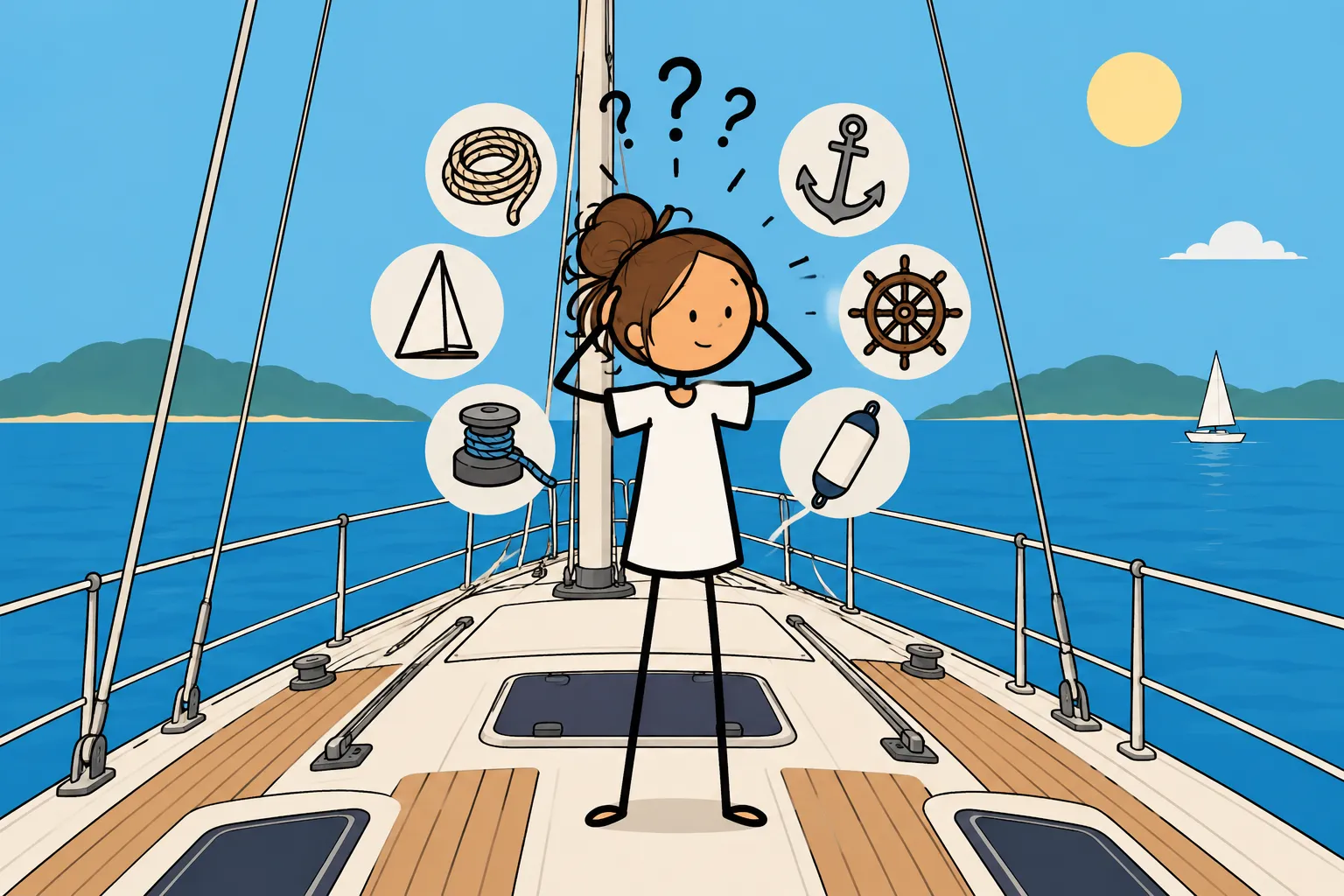
On the first day the skipper says you should "get the sheet ready and put the fenders out", and you nod without being sure what was meant. That is perfectly normal and nobody minds: no prior knowledge is needed for a week on a sailboat, and the skipper explains what you need at the start. Still, a few words make the boat feel less foreign at once.
So here are the 40 terms you will hear most often, in five groups. Each gets one sentence, the way we would explain it to a friend in the cockpit.
Do I need to know these words before I go?
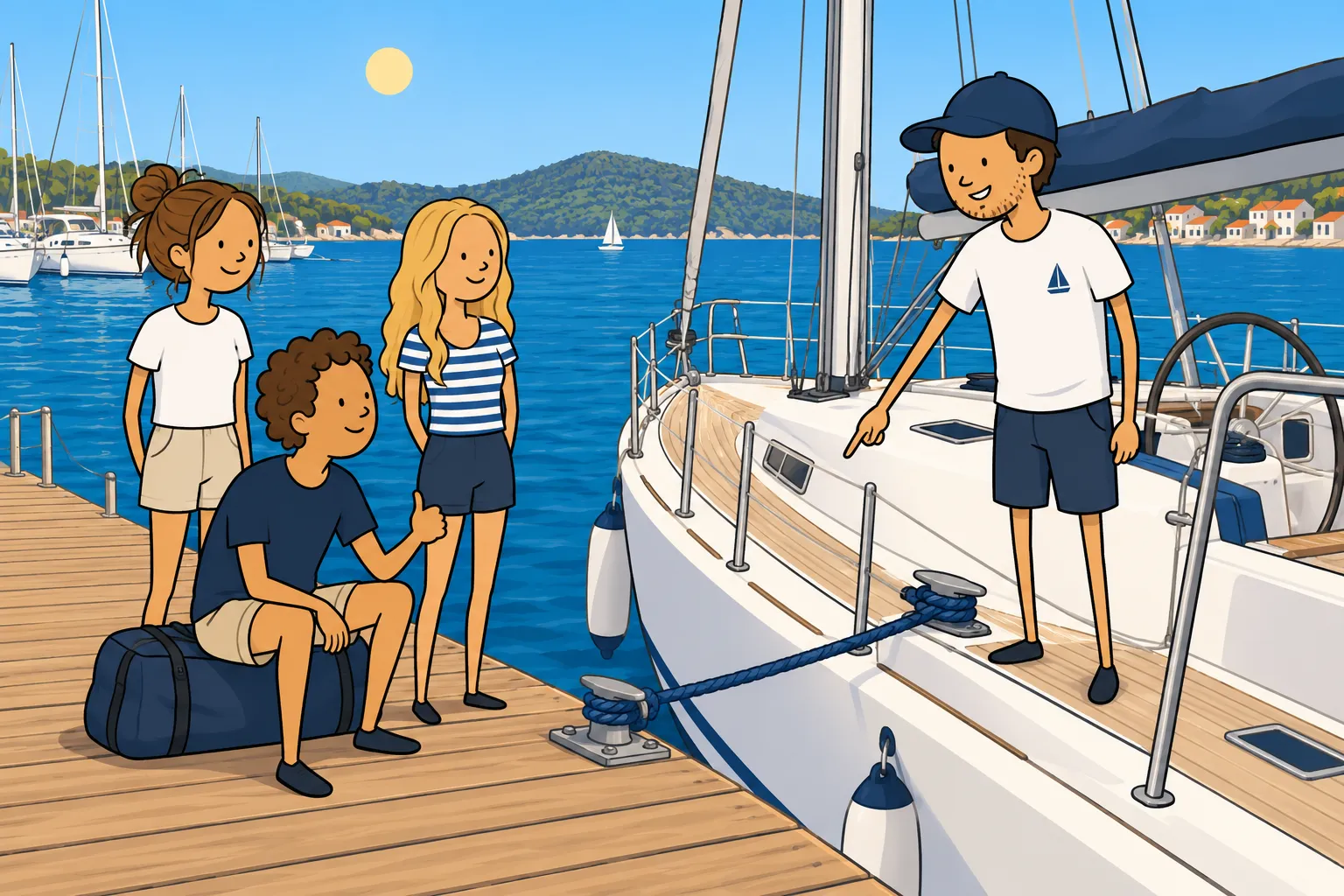
No. This is not an exam, just a guide for the curious. The skipper runs the boat and explains what is needed, and you can spend a week on board without saying a single one of these words. If you do know them, it is easier to follow what is going on around you.
To see how other crews experienced their week, read their sailing experiences.
Which words will you hear on board?
Parts of the boat
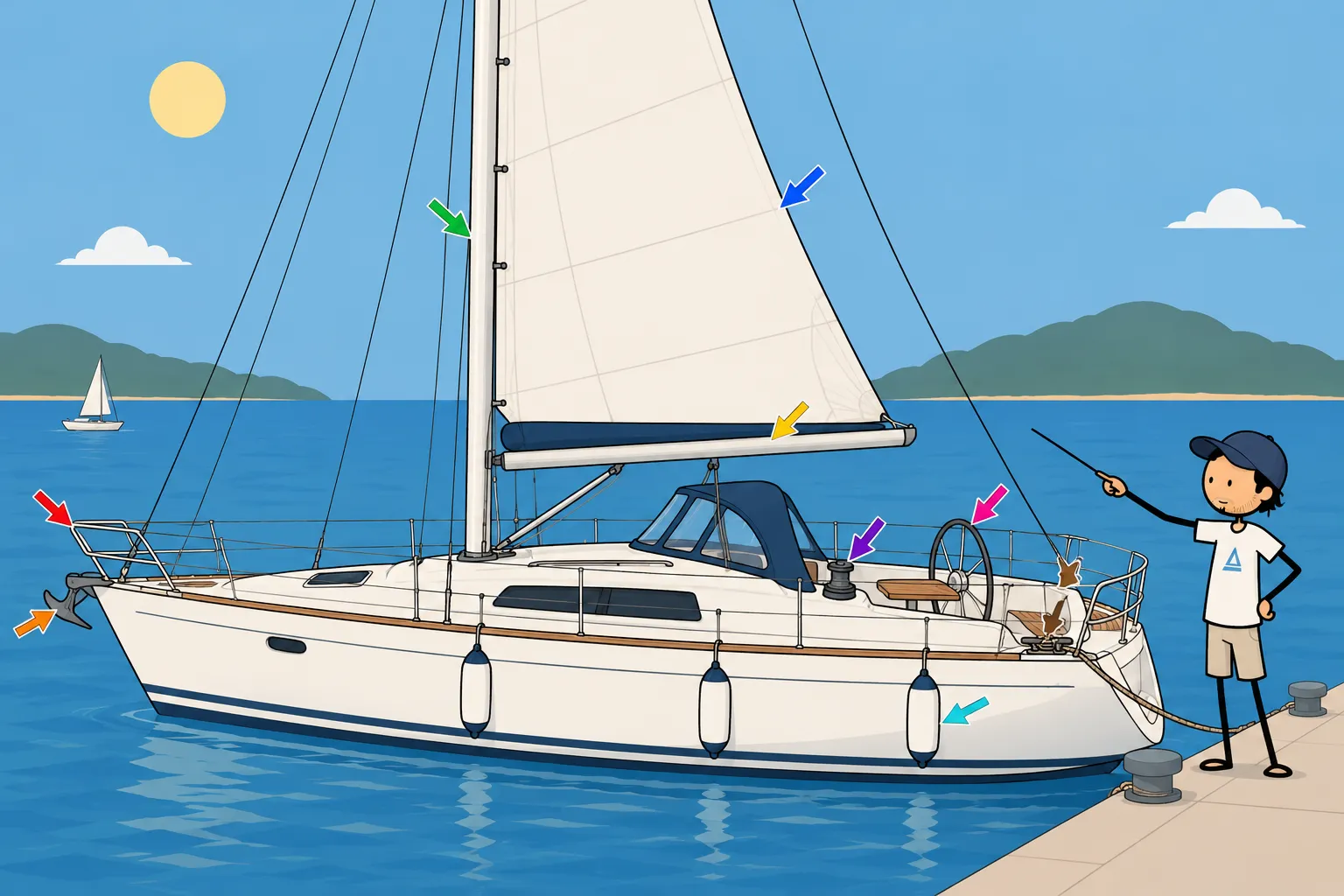
- bow - the front of the boat, the part that goes first.
- stern - the back of the boat, behind the cockpit.
- deck - the top surface of the boat that you walk on.
- cockpit - the open area at the back where people sit, eat and steer.
- mast - the tall pole that carries the sails.
- keel - the heavy fin under the hull that keeps a sailboat upright.
- helm - the wheel or tiller used to steer the boat.
- draft - how deep the lowest part of the boat sits under water, which matters in shallow bays.
Directions and movement
- port - the left side of the boat when you face the bow.
- starboard - the right side of the boat when you face the bow.
- course - the direction the boat is sailing in.
- upwind - sailing towards the direction the wind comes from, usually slower and with more heel.
- downwind - sailing with the wind behind you, usually calmer.
- heel - the sideways lean of a sailboat under sail, which is normal.
- knot - the unit of speed at sea, one nautical mile per hour (about 1.85 km/h).
- nautical mile - the unit of distance at sea, 1,852 metres.
Ropes and sails
- mainsail - the big sail raised up the mast and resting on the boom.
- jib - the smaller sail at the front, often rolled up on a furler.
- genoa - a larger jib that reaches back past the mast.
- boom - the horizontal beam along the bottom of the mainsail, so mind your head when it swings across.
- sheet - the rope that tightens or eases a sail.
- halyard - the rope that hoists a sail up the mast.
- winch - the drum a sheet or halyard is wound around so it is easier to pull tight.
- reefing - making a sail smaller when the wind picks up.
Mooring and anchoring
- anchor - a heavy metal hook that digs into the seabed and holds the boat in place.
- anchor chain - the chain that links the anchor to the boat, and its length decides how firmly the boat holds.
- windlass - the motor at the bow that lowers and raises the anchor and chain.
- cleat - a metal horn on the boat or the quay that a rope is tied to.
- fender - an inflated cushion hung over the side to protect the boat from bumps against the quay or other boats.
- mooring line - the rope that ties the boat to the quay.
- quay - the stone or concrete edge of a harbour where boats tie up.
- anchorage - a sheltered spot in a bay where a boat anchors, often for the night.
In most Greek harbours the boat moors Mediterranean style: it turns and backs towards the quay, stern first, while the anchor from the bow holds it in place. In some harbours guests help with the lines, which is basic, and the skipper explains it at the start of every week.
Weather and wind
- meltemi - the northerly summer wind in the Aegean, usually stronger in the afternoon and in July and August.
- calm - no wind at all, with a mirror-flat sea.
- gust - a short, sudden strengthening of the wind.
- Beaufort scale - a wind scale from 0 to 12, where force 4 means 11 to 16 knots.
- waves - movement of the sea surface pushed along by the wind.
- swell - waves that keep arriving after the wind has dropped.
- lee - the side or place sheltered from the wind, where the skipper looks for a bay for the night.
- forecast - the weather prediction the skipper plans the day and the route around.
Frequently asked questions
1What do port and starboard mean?
2Why do the ropes on a boat have different names?
3What is a cleat and what is a fender?
4Do I have to learn all this before sailing?
5What is the meltemi, and is it dangerous?
Your week
Learn it all in the right place - at sea
The easiest way to learn the words is on board, with the skipper. Send us an inquiry and we'll suggest a boat and a route for your week.