Sailboat vs catamaran - what's the difference and which one suits you?
Heeling or sailing flat, space, cabins, shallow bays, room in harbour and price. A fair comparison of sailboats and catamarans, and who each one suits.
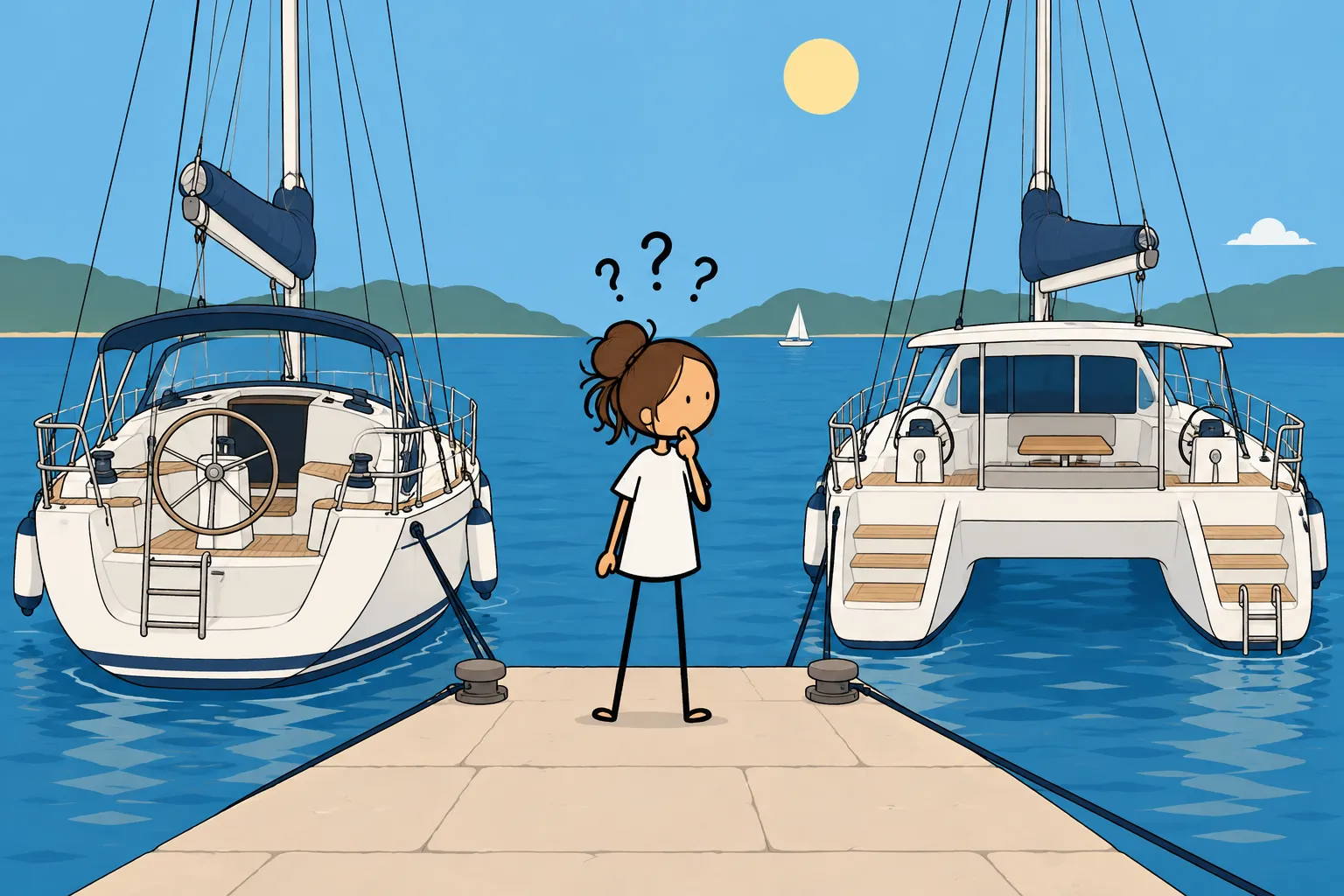
Sailboat or catamaran? It's one of the first questions a group asks when they start choosing a boat for a week at sea, and one we hear all the time. Both boats sail, both come with a skipper, and on both you'll swim in bays you can only reach from the water.
The short answer: a sailboat leans over under sail, gives you the real feeling of sailing, usually costs less and finds a berth more easily in a busy harbour. A catamaran sails flat, has far more space and takes a bigger group, but usually costs more. Below is everything point by point, without rooting for either.
What's the basic difference between a sailboat and a catamaran?
It comes down to the hull. A sailboat has one hull with a heavy keel underneath, which keeps it upright and stops the wind pushing it sideways. A catamaran has two hulls joined by a wide deck, and it's stable because of that width, not because of weight under the water.
Every other difference follows from that:
- Under sail: a sailboat leans over, up to about 20°, while a catamaran sails flat.
- At anchor: a sailboat rolls side to side in a swell from the side, while a catamaran rolls much less.
- Space: a sailboat has the saloon and galley below deck, while a catamaran has the saloon level with the cockpit and much more room.
- Draft (depth below the waterline): deeper on a sailboat, much shallower on a catamaran.
- In harbour: a sailboat is narrower and finds a berth more easily, while a catamaran is up to twice as wide and harder to place in high season.
- Charter price: usually lower for a sailboat, usually higher for a catamaran.
How do they sail: heeling or flat?
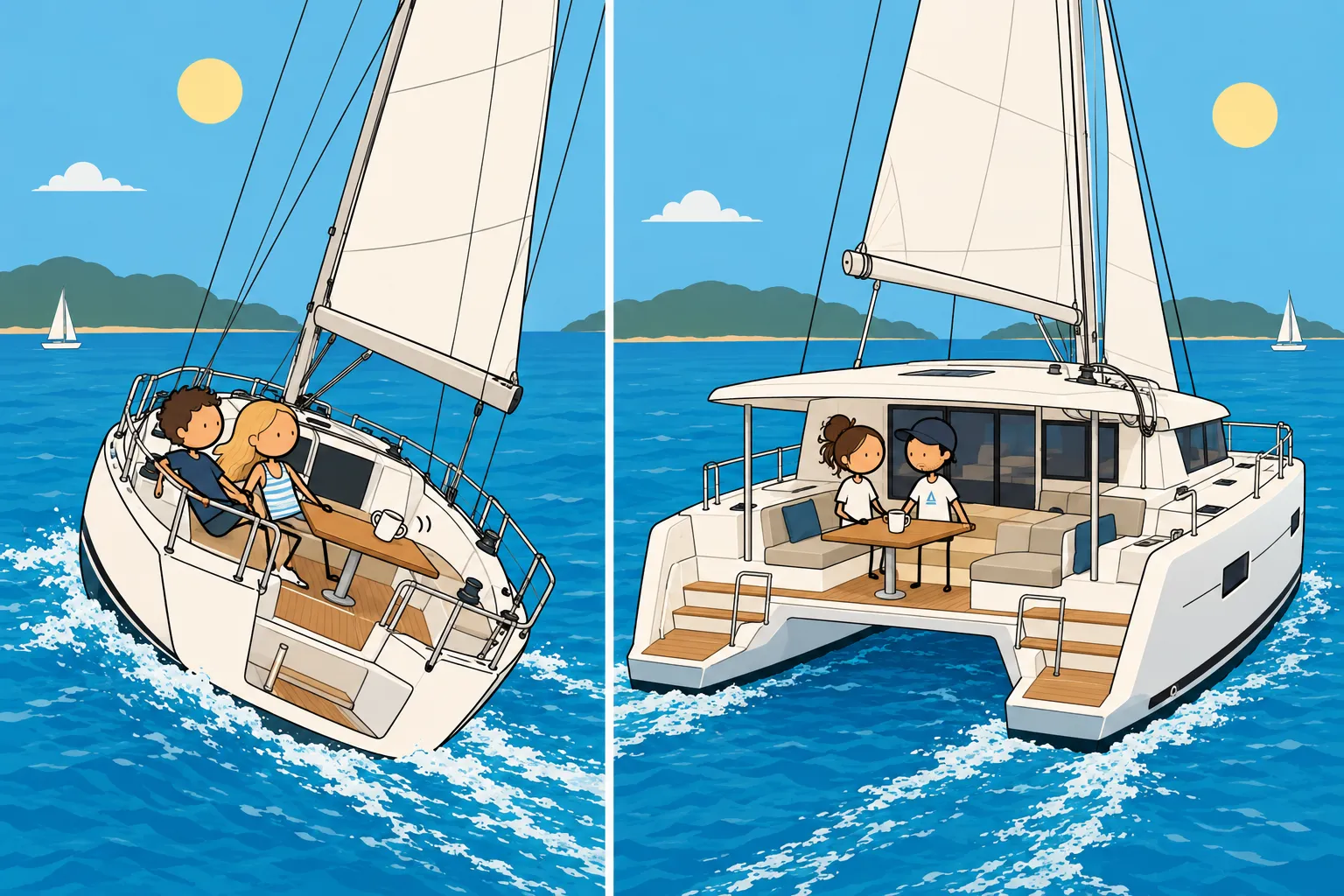
This is the difference you'll feel most.
- A sailboat heels. When the wind fills the sails, a sailboat leans to one side, up to twenty degrees or so in a stronger breeze. That's normal and the boat is built for it. If it makes you uneasy, the skipper can ease the sails to bring it more upright.
- A catamaran sails flat. Things mostly stay where you put them, and walking around the boat is easier while you sail.
- The feeling of sailing is stronger on a sailboat. It answers every gust: the boat speeds up, leans in, and the helm comes alive in your hand. For many people that's the whole point of sailing. A catamaran feels more like a terrace that sails.
- Speed depends on the wind. With enough wind from the side or behind, modern catamarans are surprisingly fast. In light wind and when sailing upwind, a sailboat usually does better, and a catamaran turns its engines on more often.
- A catamaran moves too. There's no heel, but it has its own rhythm in waves: it can pitch forward and back, and when heading straight into the waves, the deck between the hulls sometimes slaps the water. So for people worried about seasickness, a catamaran is often the calmer choice, but not a magic fix.
What are they like at anchor and in shallow bays?
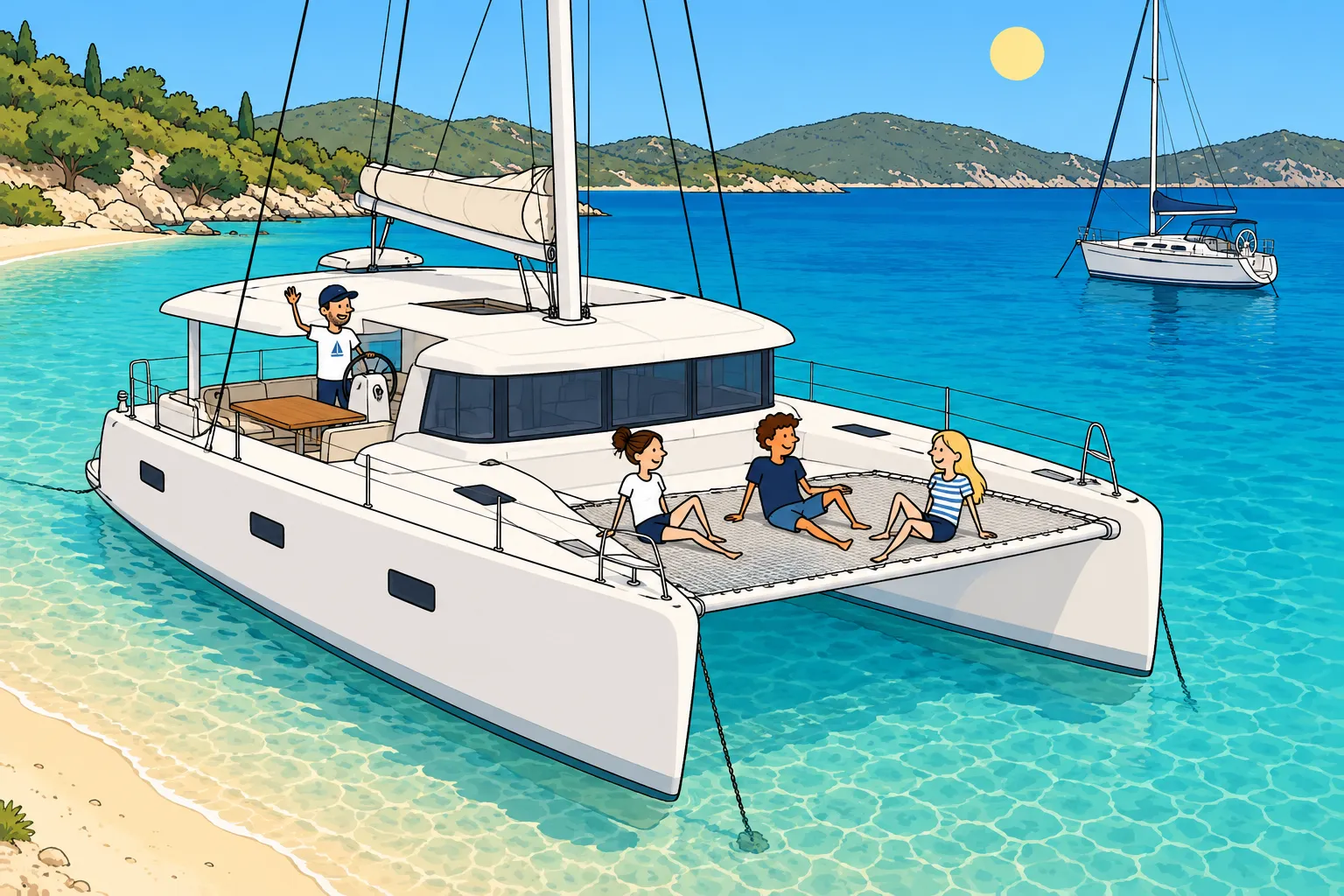
The boat spends a good part of the day in a bay while you swim and have lunch, so this matters too.
- Rolling. Experienced skippers pick calm, sheltered bays for swimming and for the night, so at anchor the boat is usually still. If a wave does come from the side, from a passing ferry or when the wind shifts, a sailboat can roll from side to side, while a catamaran, being so wide, does it much less.
- Shallow bays. A catamaran has a much shallower draft than a sailboat, so it can anchor in shallower bays and closer to the beach. Where it's safe to stop is always the skipper's call.
- The bow net. On most catamarans a net is stretched between the two hulls at the front, and at anchor it's a great place to lie above the water. Some models have a solid deck there instead.
How much space, and for how many people?
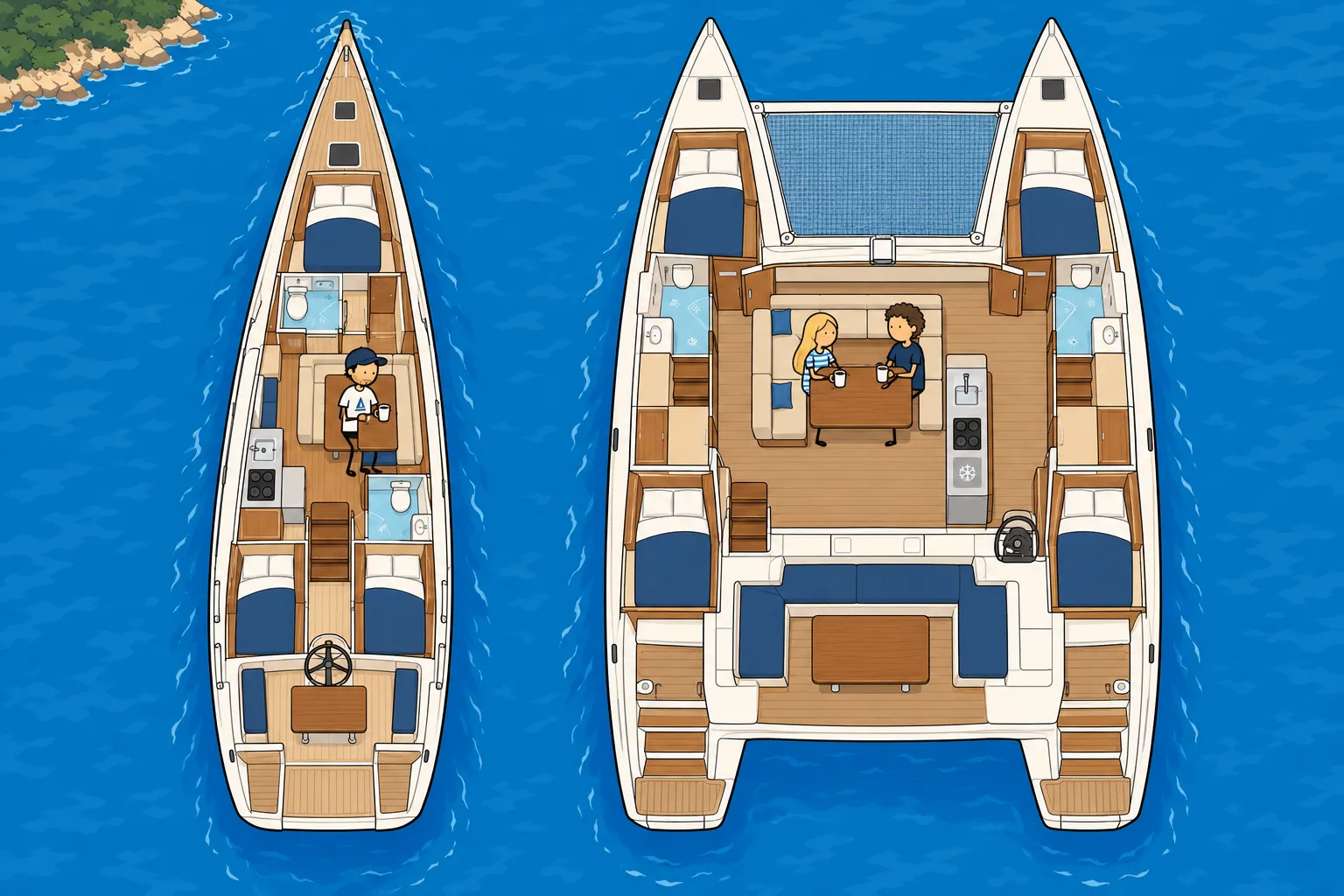
Here the catamaran wins clearly: a catamaran of about 12 to 13 metres (40 to 42 feet) has roughly the space of a 15-metre (50-foot) sailboat.
- Saloon and cockpit. On a sailboat, the saloon and galley are below deck, a few steps down, and the cockpit is outside. On a catamaran, the saloon and cockpit are on one level, with no steps and big windows all round, so you're together even when some are inside and some are out.
- Cabins. A charter sailboat has 3 to 6 cabins, a catamaran 4 to 6. Cabins are single, double or triple, and the saloon seating can usually be turned into a double bed.
- Privacy. On a sailboat, the cabins are at the front and back, below deck. On a catamaran, they're split between the two hulls with the saloon in between, so two couples can each have their own hull.
- Bathrooms and layout. On many sailboats, two cabins share one bathroom. On a catamaran, the number of bathrooms and the layout depend on the catamaran's size and its maker (for example Lagoon or Bali).
What are they like in harbours and marinas?
- Width. A catamaran can be up to twice as wide as a sailboat. In Greek harbours, boats mostly moor stern-to, side by side along the quay, so a catamaran takes up much more room.
- Busy harbours in high season. In July and August, when harbours fill up, it's harder to find room for a catamaran, so it pays to arrive earlier in the afternoon. A sailboat usually finds a spot more easily.
- Harbour fees. Many marinas charge catamarans more because of their width, and how much more varies from marina to marina. Marina and port fees aren't in the boat price, so the crew pays them during the week.
- Help with mooring. On both boats, in some harbours guests help with the lines: passing or throwing a line, tying it to a cleat, setting the fenders. It's basic, needs no prior knowledge, and the skipper explains it at the start of every week.
Is a catamaran more expensive than a sailboat?
Usually, yes. Chartering a catamaran usually costs more than a sailboat of similar length, and marinas often charge it a higher fee as well.
A catamaran does take more people, though. If you fill the extra cabins, the difference per person is smaller than the difference in the boat price.
The total cost of sailing depends on the dates, the destination and the boat, and food, drinks, fuel, marina and port fees are paid separately, whichever type of boat you choose.
Who is a sailboat for, and who is a catamaran for?
There's no wrong choice: both come with a skipper, so you don't need experience for either. It's only a question of what matters more to you.
A sailboat is the better choice if...
- you want the real feeling of sailing, with the heel, the wind and a helm that responds
- you're a smaller group, up to eight people
- the price of the boat is a big part of your decision
- you don't mind the boat leaning a little (for some, it's the best part of the week)
A catamaran is the better choice if...
- you're travelling with children: the boat is stable, sails flat, and the saloon and cockpit are on one level
- you're a bigger group, or a few couples who value their privacy
- heeling worries you, or you're prone to seasickness
- you're more about swimming, sunbathing and time at anchor than the sailing itself
- you like anchoring in a shallow bay close to the beach
Frequently asked questions
1Is a catamaran better for beginners?
2Is it dangerous when a sailboat heels?
3Is a catamaran faster than a sailboat?
4How many people fit on a sailboat, and how many on a catamaran?
5Is there a skipper on a catamaran too?
Your week
Still deciding between a sailboat and a catamaran?
Tell us how many of you there are, when you'd like to sail and what your budget is, and we'll suggest boats that fit, sailboats and catamarans alike.