Catamaran models - what actually changes from one to the next
Length, cabins, owner's version, crew cabins, flybridge, year of build and equipment: what really differs between catamaran models, and how to read a listing.
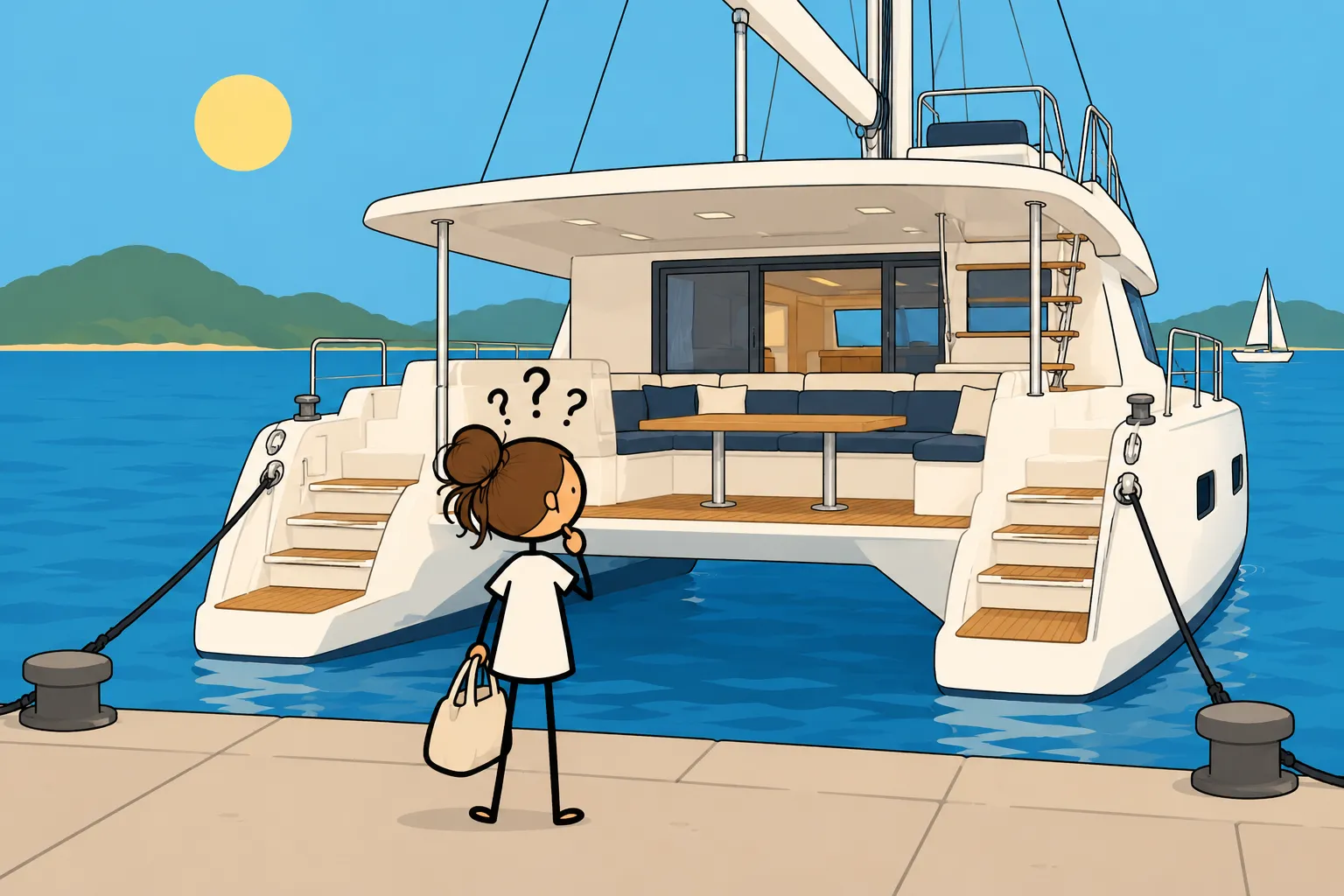
Once you've chosen between a sailboat and a catamaran, the next question comes quickly: which catamaran? Browse catamarans in Greece and you'll see names like Lagoon 42 or Bali 4.6, boats built years apart, and notes like "4+2 cabins" or "flybridge". What do they mean for your week?
Quite a lot. Two catamarans can look alike in photos and still give your group a very different week: on one, every cabin has its own bathroom, on the other two cabins share one; one has air conditioning, the other doesn't. Here's what changes from model to model, and how to read a boat's details before you book.
What does the number in a catamaran's name mean?
Most builders put the length in the name, in feet (one foot is about 30 cm). A Lagoon 42 is about 42 feet long, and the Bali 4.6 is, in the builder's own words, a 46-footer. Charter catamarans run from about 38 to 55 feet and more, roughly 11.5 to 17 metres.
Don't be surprised if the same boat shows up with two different lengths. Some listings give the length of the hull, others the length overall, with everything that sticks out. Lagoon gives its 42 a hull length of 12.79 m and 13.22 m overall.
The differences between builders, for example Lagoon or Bali, are a topic of their own. Here we look at what changes from model to model, whatever the brand.
What changes with a longer catamaran?
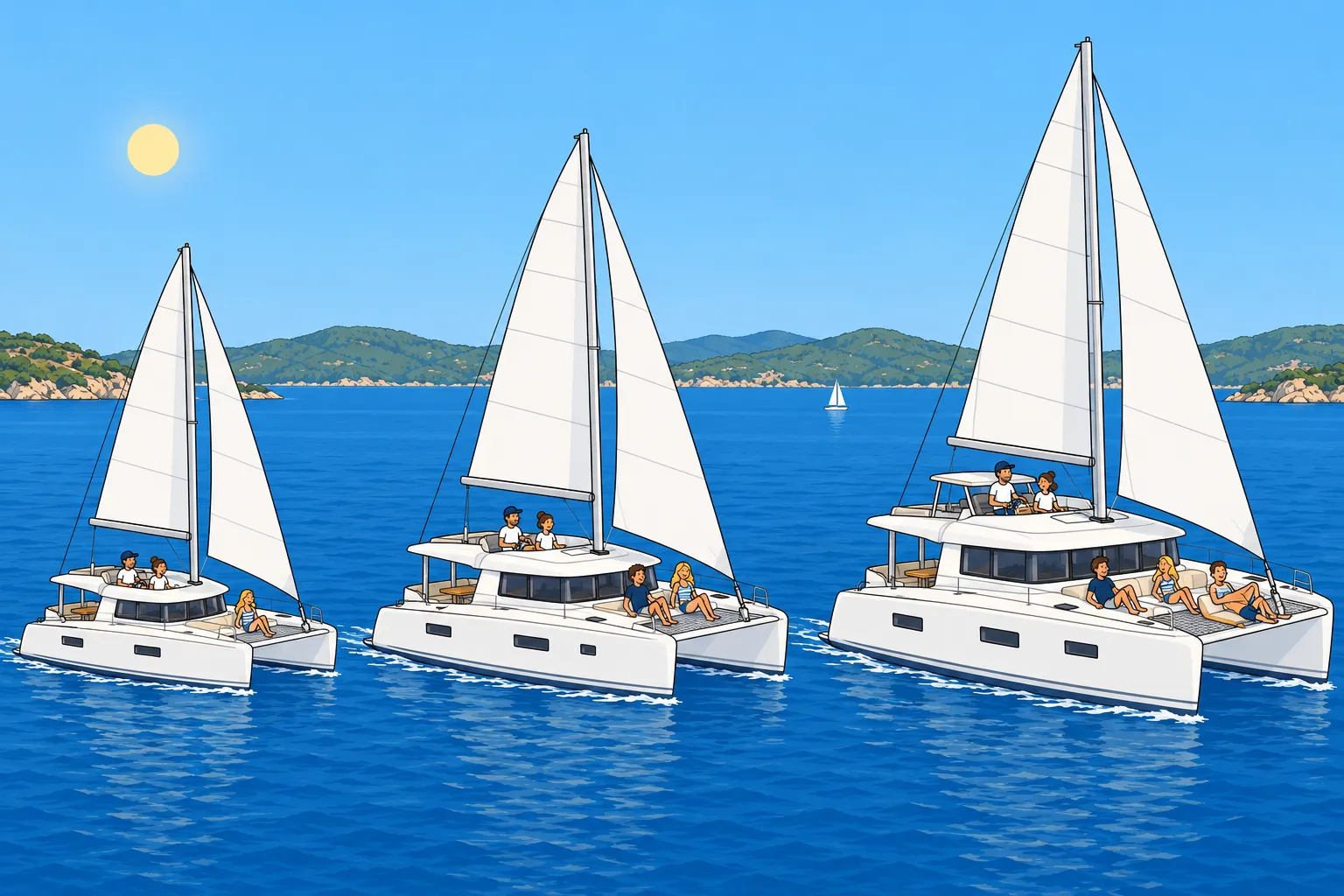
A few extra feet don't sound like much, but on a catamaran they add up, because the boat grows in width too: Lagoon's 38 is 6.65 m wide, its 55 a full 9 m.
- Space: bigger cabins and bathrooms, a roomier saloon and cockpit, more deck to lie in the sun.
- Cabins: most charter catamarans have 4 to 6. Smaller models come with 4 (or 3 in an owner's version), the largest with up to 6: Lagoon builds its 55 with 4, 5 or 6.
- Guests: the number of berths a builder gives is a maximum that includes the saloon and the bows: 6 to 10 on the Lagoon 38, 8 to 16 on the Lagoon 55. On a skippered sailing week there can be usually at most 11 guests plus the skipper, whatever the number of berths, and the skipper and a hostess count towards each boat's own maximum, and for a comfortable week count two people per cabin.
- Price: a bigger boat costs more for the week, but shared between more guests, the price per person can stay close.
- Fuel and marinas: neither is in the boat price, and both grow with size. Lagoon's 55 has two 110 hp engines, its 38 two of 29 hp. Marinas charge by length, some by length times width (Flisvos marina in Athens, for example), and catamarans sometimes pay 50% more than a sailboat of the same length, depending on the marina.
How many cabins and bathrooms does a catamaran have?
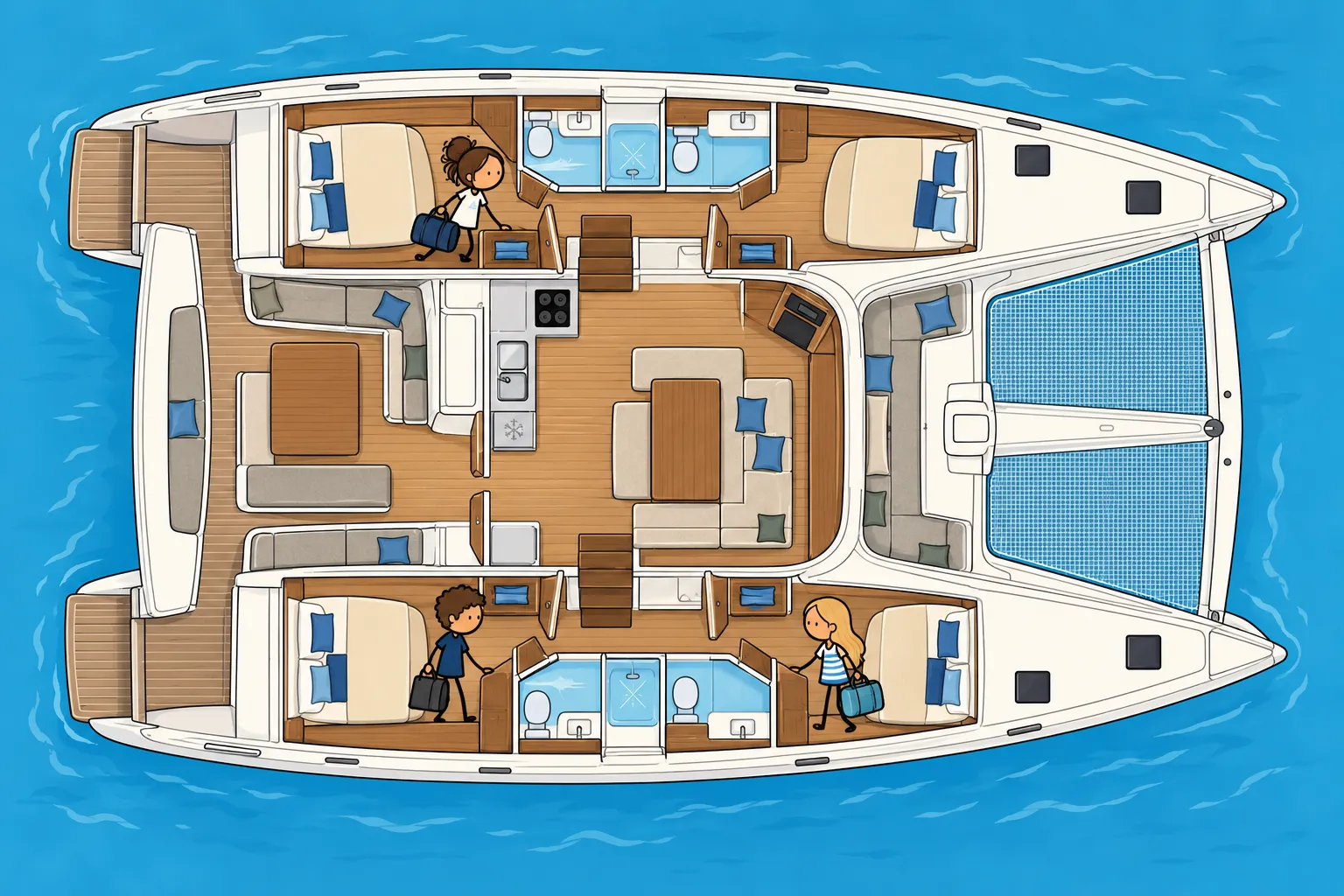
For your week, the layout matters more than the brand. A catamaran has two hulls, the cabins sit inside them, and the saloon is in the middle, between the hulls.
4-cabin version
The classic charter layout: two double cabins in each hull, one at the front and one at the back. On many charter boats every cabin has its own bathroom, but not on all: Lagoon builds its 51 with 4 cabins and 4 bathrooms, and also with 4 cabins and 3. It suits 8 guests, two per cabin.
6-cabin version
Larger models, like the Lagoon 51 and 55, also come with 6 cabins (the 55 with 5, too). The cabins are smaller and some share a bathroom: the Lagoon 51 in this version has 6 cabins and 4 bathrooms. It's the layout for bigger groups who'd rather have more beds than more space.
Owner's version
On many catamarans, the "owner's version" gives one whole hull to a single cabin: a big double bed, a bathroom of its own with a separate shower, and plenty of storage. The other hull has two cabins. That makes 3 cabins in total, so it suits a family, or three couples where one gets the "master" cabin. Charter catamarans are usually designed to carry as many guests as possible, so the owner's version is the rarer choice in charter.
Crew cabins in the bows
At the very front of each hull, many catamarans have a small cabin with a single berth, often reached only through a hatch on deck. They're usually what the "+2" in "4+2 cabins" stands for. These cabins are meant for a skipper or a hostess and, on a full boat, for children; on some smaller models the berth is only 1.65 to 1.70 m long. Not all of them have a toilet, and then the crew uses the guest bathrooms.
Why it matters to you: when the skipper sleeps in the bow, all the double cabins stay with your group. On boats where the bow berths are too small, the skipper takes one of the guest cabins. The same goes for a hostess, whom we recommend if you want a week with no obligations at all. Check this before you count beds.
Flybridge or no flybridge: does it matter?
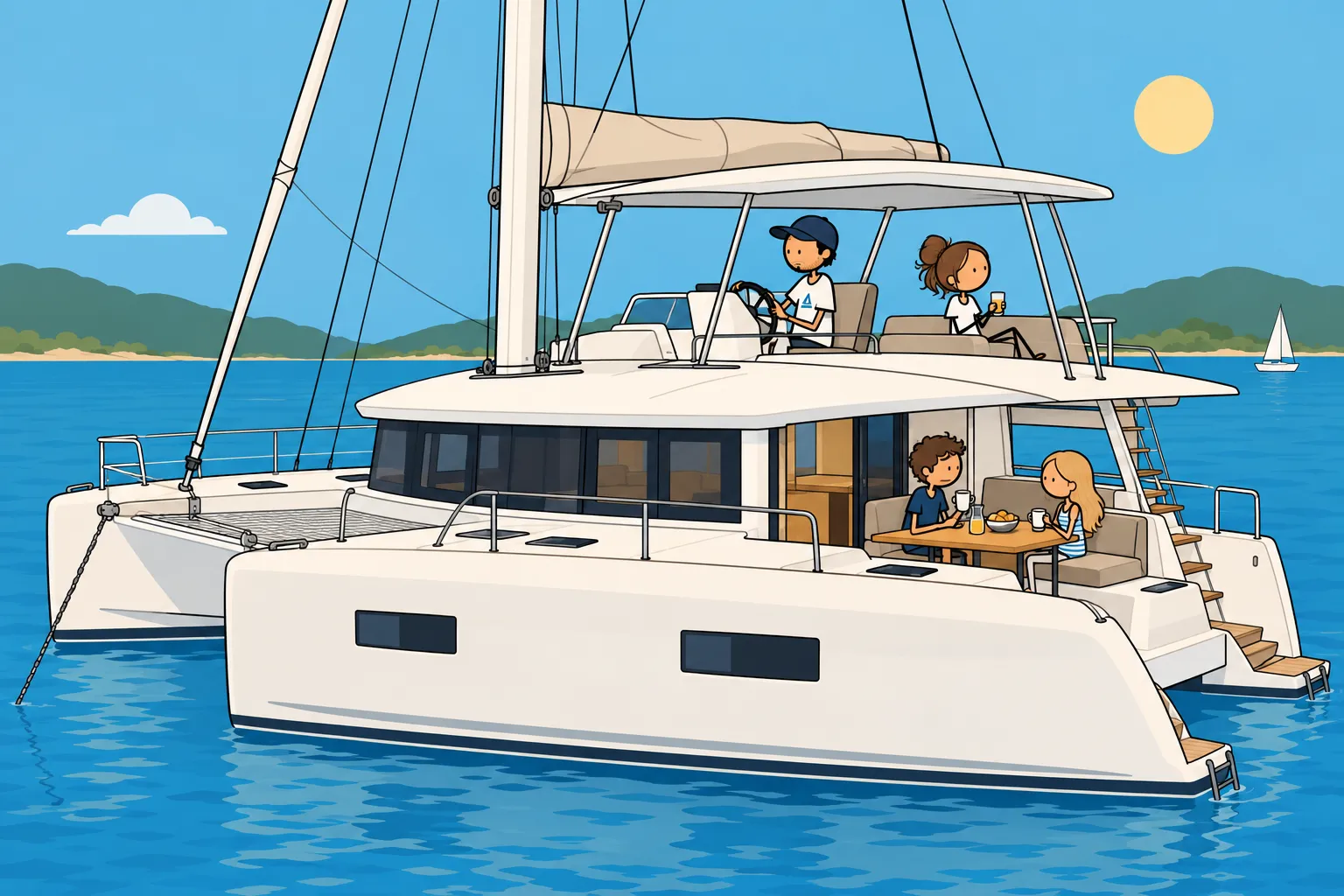
A flybridge is an upper deck on the roof, with the helm and a lounge area. The Lagoon 51 and 55 have one, for example, and flybridges are showing up more and more on smaller catamarans too.
- For: one more outdoor space, with the best view on board and sun pads. From up there, the skipper also sees well ahead of the boat when mooring and dropping anchor.
- Against: the taller boat catches more wind, which makes it harder to manoeuvre in a tight harbour when it's blowing (that's the skipper's concern, not yours). There are more steps to climb, and when the skipper steers from up there, they're a level away from the group in the cockpit.
- When there's no flybridge, the helm is usually at the back of the cockpit or against the saloon wall, close to everyone.
Neither is better. If your group loves sunbathing with a view, a flybridge is a bonus; if you'd rather all be together in the cockpit, you won't miss it.
How much does the year of build matter?
Less than you might think, as long as the boat has been well looked after.
- Same name, different boats: builders update their models over time. The Lagoon 46 and 51 now come in "Iconic" versions with a redesigned forward lounge, so two boats with the same name from different years can look quite different.
- Where age shows: cushions, mattresses, bathrooms, electronics and sails. A newer boat has been through fewer seasons.
- Refits: a refit means the boat has been renewed, for example with new upholstery, sails, electronics or engines. If a listing mentions one, ask what exactly was done. A recently refitted older boat can be a better choice than a newer one with worn cushions.
- Price: an older boat of the same size usually costs less for the week, which can leave room for a bigger boat or extras.
What equipment varies from boat to boat?
This is where two boats of the same model differ most, because equipment depends on what was fitted to that particular boat.
- Generator: on boats that have a generator, the 220V sockets also work at anchor while it runs, not only when the boat is plugged in at a marina.
- Air conditioning: some catamarans have it, many don't. It runs only on the generator or shore power, and it's fairly loud, so running it all night isn't pleasant. With the hatches open, a catamaran airs out well without it.
- Watermaker: it makes fresh water from seawater, so the boat depends less on topping up the tanks in harbours.
- Inverter: it turns 12V battery power into 220V for small devices, like a laptop charger. It doesn't make power, so a hair dryer or air conditioning would drain the batteries fast.
- Dinghy and outboard: the dinghy is your "car" for getting ashore from an anchorage. Charter boats have one, but the outboards differ, and a stronger one gets a full dinghy to shore more easily.
- Paddleboard (SUP) and snorkelling gear: on some boats they're part of the equipment, on others an extra.
How do you read a catamaran listing?
Every boat in our yacht catalogue shows its length, cabins, berths and equipment, and you can always ask us for the year of build and any refit. Here's what to look at:
- 1. Year of build, and the year of the refit if there was one.
- 2. Cabins, e.g. "4+2": four double cabins plus two small ones in the bows. The notation isn't standard, so if the "+" isn't explained, ask what it means.
- 3. Berths, e.g. "8+2": beds in the cabins plus extra ones in the saloon or bows. For comfort, plan around the first number.
- 4. Bathrooms (listed as heads or WC): compare them with the cabins. Four cabins and four bathrooms means every cabin has its own.
- 5. Length in metres or feet, and whether there's a flybridge.
- 6. Water tank: from about 300 litres on smaller models to nearly 1,000 on the largest. Without a watermaker, a smaller tank means more frequent top-ups.
- 7. Equipment: generator, air conditioning, watermaker, inverter, outboard power, paddleboard. If something isn't on the list, don't count on it.
- 8. What costs extra: Wi-Fi on board and beach towels, unless the boat lists them as included.
Frequently asked questions
1What size catamaran do we need for 8 people?
2Is a newer catamaran always better?
3Where does the skipper sleep on a catamaran?
4Can adults sleep in the bow cabins?
5Do catamarans have air conditioning?
Your week
Not sure which catamaran fits your group?
Tell us how many you are and what matters most to you on board, from bathrooms to air conditioning, and we'll suggest boats that fit. We'll get back to you as soon as you send an inquiry.