How long to stay on one island or in one cove - what sets the pace of a sailing week
Can you stay two nights in the same cove or harbour? What decides it - the Friday return, water in the tanks, harbour berths, marine parks and the weather.

“If we fall in love with a cove, can we stay one more night?” It's one of the questions people ask before a sailing week in Greece, and the answer is simpler than many expect.
There's no fixed rule. The skipper proposes the route and puts it together around the weather and the guests' wishes, so two nights in a place you loved is quite possible. A few things do shape how long a boat can stay put: the Friday return, water in the tanks, berths in harbour, protected-area rules and the weather.
Is there a rule for how long you stay in one place?
No. You don't get a fixed itinerary with a set number of nights per island. The skipper lives on board with you, checks the forecast every day and proposes where to go next, and your wishes are part of that plan.
Most mornings you wake up somewhere new, but nothing obliges you to do that every day. If the group loves a cove or a town, you can stay another night. If everyone wants a lazy day, the boat barely moves.
A week has a limited number of nights, though, so every second night in one place means one place fewer on the route. It's worth saying early on, when you first talk through the route with the skipper at the start of your week on a sailboat, whether you'd rather have more places or more calm.
Why does the Friday return shape the whole route?
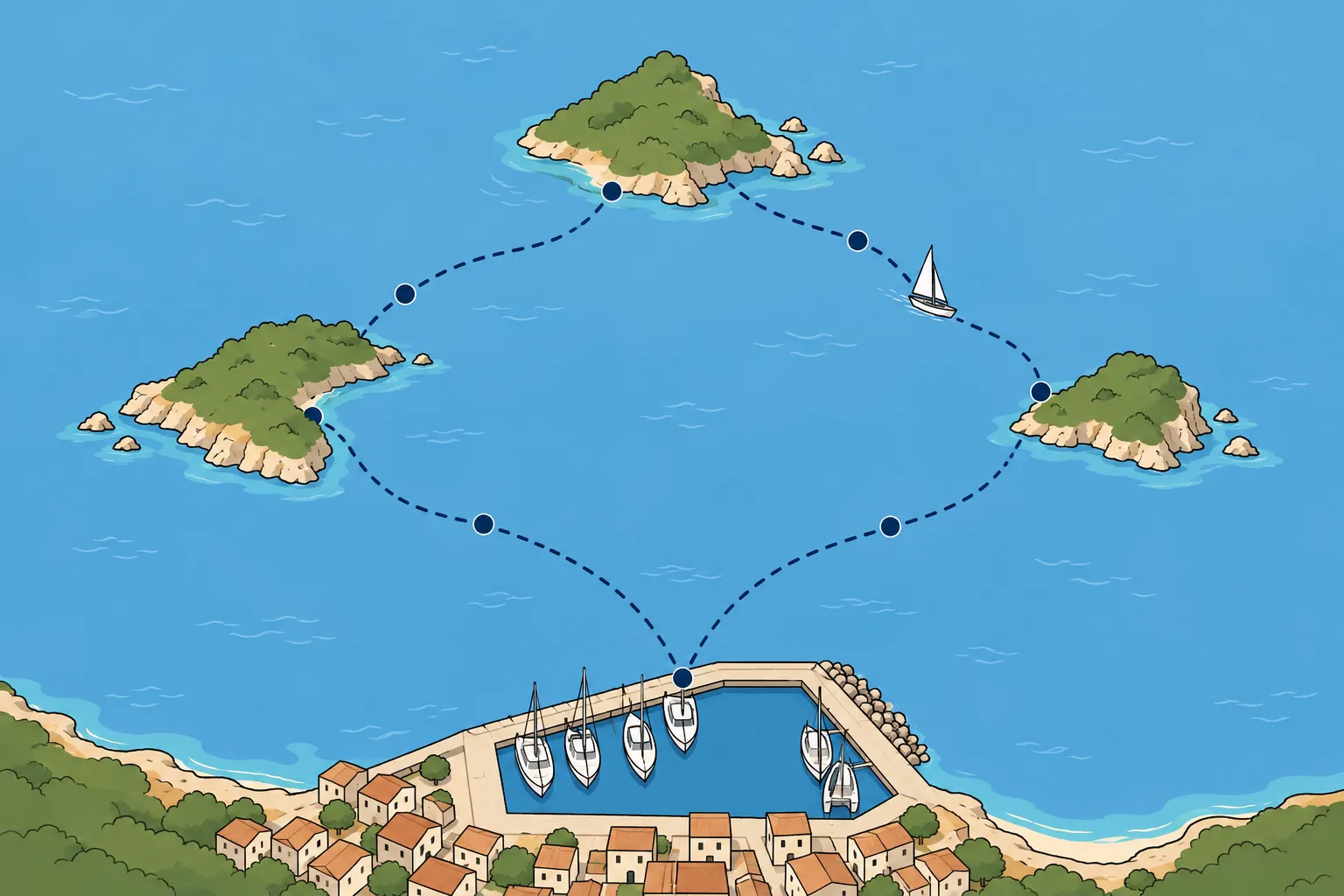
Only the start and end of the week are fixed. Check-in is Saturday from 17:00, and the boat has to be back at the home marina by 18:00 on Friday, where you spend the last night.
So the route isn't just a string of places but a loop that closes on Friday. The farther the boat is from the home marina on Thursday evening, the longer the last day's sail, so two nights on a distant island late in the week have to fit the way back. On the Ionian the legs are short, so an extra night in one spot fits more easily.
Wind counts too. In the Aegean the meltemi blows in summer, a northerly that's strongest in July and August. It usually starts in the early afternoon and dies down by sunset, but it can blow through the night and for days in a row, sometimes up to ten. When the way back is upwind, sailing guides advise leaving at dawn. That's why the skipper may suggest moving closer to the home marina in the last days, so Friday isn't a long, tiring day.
How many nights in a row can a boat stay at anchor?
The tanks decide most of it. A boat carries a few hundred litres of fresh water for showers, the sink and brushing teeth, and refills in harbour every day or two. After a night or two at anchor, it's usually time for a harbour.
- Water: in harbour the tanks are filled from taps on the quay. A boat with a watermaker, a device that turns seawater into fresh water, can stay longer in calm coves, but it's extra equipment not every boat has.
- Power: the fridge and lights run on batteries, which charge while the engine runs or when the boat is on shore power.
- Fuel: not included in the boat price, and it's taken on at certain harbours and marinas.
- Food: small places have a smaller choice, so keep basics and bottled water for a day or two.
That's why nights at anchor naturally alternate with nights in harbour, where water and groceries are topped up and dinner is ashore.
Can you stay two nights in the same harbour?
Yes, and it's often the easiest way to spend longer on one island. In harbour you top up water and power, shops and bakeries are close, and you can explore the island by land.
Count on berth space. Greek harbours mostly moor stern-to along the quay, side by side, and in July and August popular harbours fill quickly. Sailing guides therefore advise arriving early, typically before 15:00. Famous coves are the same: for Panormos on Skopelos, sailingissues.com advises arriving before noon at weekends in season.
Marina and harbour fees aren't in the boat price, so the crew pays them during the week. The amount depends on the place and the size of the boat.
Where can't you stay overnight?

At sea it isn't only wishes that decide, there are rules too. A few examples from Greece:
- The marine park near Alonissos. The Sporades have the Alonissos Northern Sporades National Marine Park, divided into zones. No boat may come within 3 nautical miles (about 5.5 km) of Piperi, except vessels with a permit. At some islands yachts may stay only from sunrise to sunset, and on Kyra Panagia overnight stays are allowed only in Agios Petros and Planitis bays. Along part of Alonissos's north-west coast, within 200 metres of the shore, no boat may stay overnight.
- Swimming beaches. In summer, local port authorities can ban anchoring at certain beaches. Heraklion on Crete banned anchoring and mooring at a list of beaches for summer 2026, and keeps vessels 100 metres from the swimming-zone buoys.
- Underwater cables. Anchoring is banned above underwater power cables, and the spots are marked with warning signs on shore.
You don't need to check these yourself. The skipper is an experienced, licensed professional who knows these waters and builds them into the route.
What if the weather decides for you?
Sometimes neither you nor the skipper decides how long you stay, the wind does. When the weather turns, the plan changes or the boat waits in a safe harbour. Safety always comes first.
So a week sometimes includes a stay nobody planned: a day or two in harbour. That isn't a lost day. You explore the island by land, go to a beach or have a long lunch in a taverna, while the boat waits safely moored.
What do two nights in one place look like in practice?

These are examples, not a fixed plan: what happens in your week depends on the weather and your group.
Two nights in a town harbour
You arrive in the afternoon, wander through town and have dinner on the waterfront. The next day the boat stays tied up while you explore the island, hit a beach or sit in a quayside cafe. Water and groceries get topped up along the way.
Two nights in the same cove
When the cove is sheltered and the forecast calm, you can stay a second night: a whole day of swimming and snorkelling without lifting the anchor. It helps to stop at a harbour for water beforehand.
A lazy day with a short sail
An hour or two to a neighbouring cove brings a new swimming spot and costs almost nothing in rest.
More places, shorter stays
Some groups want to see as many islands as possible, so almost every night is somewhere new. Neither approach is wrong. Just tell the skipper what suits you.
Frequently asked questions
1Can we spend the whole week in one cove?
2Do we have to sail every day?
3Who decides whether we stay another night?
4Do we pay extra for two nights in a harbour?
5What if one week isn't enough?
Your week
Want a week with more time in one place?
Tell us when you'd like to sail, how many of you there are and whether you'd rather have more places or more calm, and we'll suggest boats that fit.