Watermaker on a boat - fresh water straight from the sea
How a boat watermaker turns seawater into fresh water, what it changes on a sailing week, whether you can drink the water, and which boats have one.
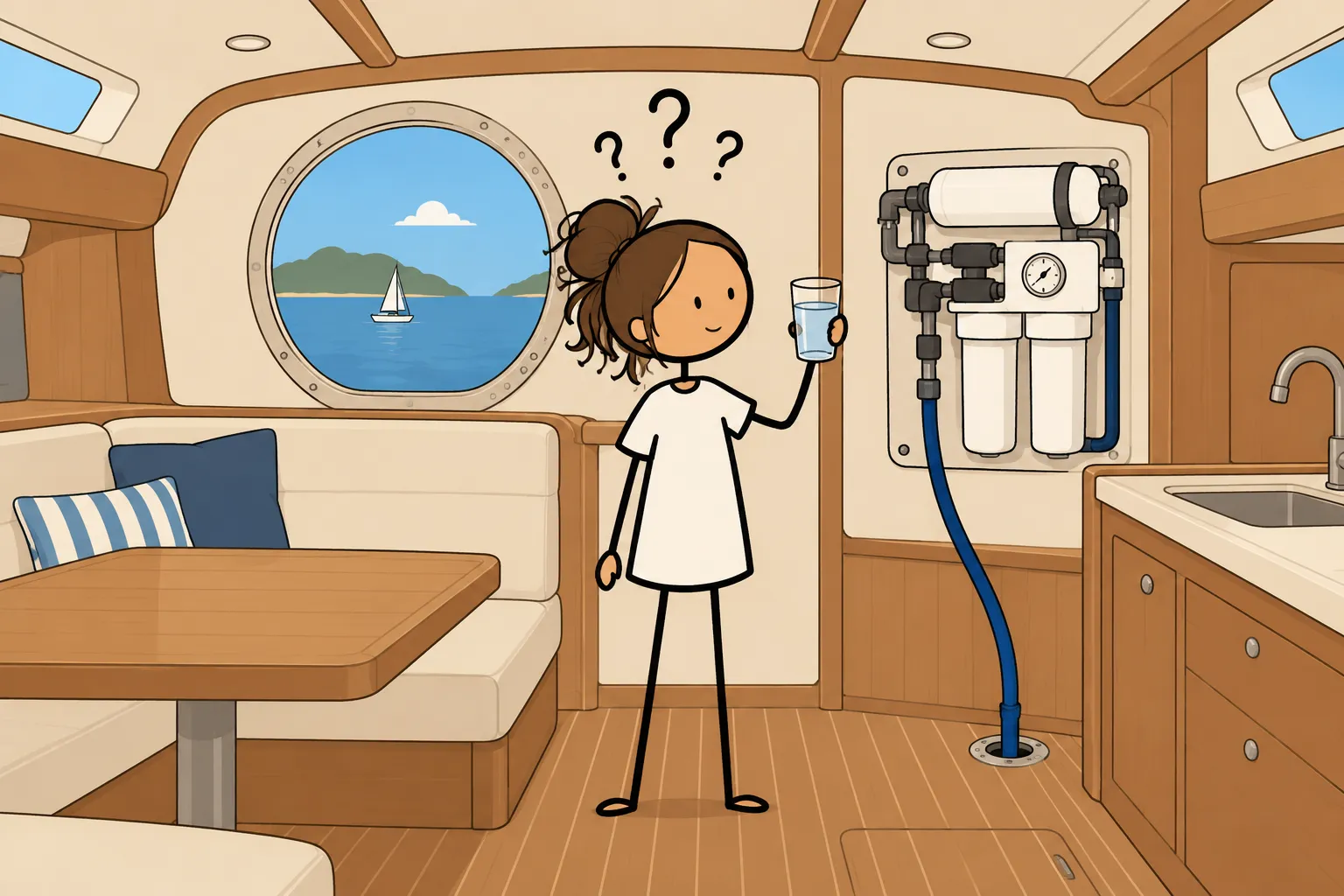
In the important notes on our Ionian sailing week and the other route pages, there's a short line: "Fresh water is limited (without a watermaker)." The part in brackets deserves an explanation.
A watermaker is a small desalination unit on board: it turns seawater into fresh water. Here's how much water a boat has without one, how a watermaker works in plain words, what it changes on a sailing week, and whether you can drink what it makes.
What is a watermaker?
A watermaker takes in seawater, removes the salt and sends the fresh water to the boat's tanks, right there at sea. Technically it's a desalinator, but on boats everyone calls it a watermaker.
It's the same idea many Greek islands depend on. Sifnos in the Cyclades, for example, gets much of its water from desalination plants. A watermaker is a far smaller version of the same thing, sized for one boat.
How much fresh water is there on a boat without a watermaker?

A typical charter boat carries a few hundred litres of fresh water in its tanks. That water does everything: showers, the galley sink, washing up, brushing teeth. The toilets flush with seawater, so they don't use any.
For a sense of scale, the watermaker manufacturer Schenker estimates that a crew of 5 on a sailboat uses 150 to 200 litres a day. With a full boat, the tanks last about two days, so the boat stops in a harbour every day or two to refill.
That's the everyday rhythm of life on a sailboat: swim in the sea first, then a quick rinse, and turn the water off while you soap. It works well, but it does shape the week. And on some islands harbour water can't be taken for granted. On the Cyclades, water gets scarce in summer, when the islands fill with visitors.
How does a watermaker turn seawater into fresh water?
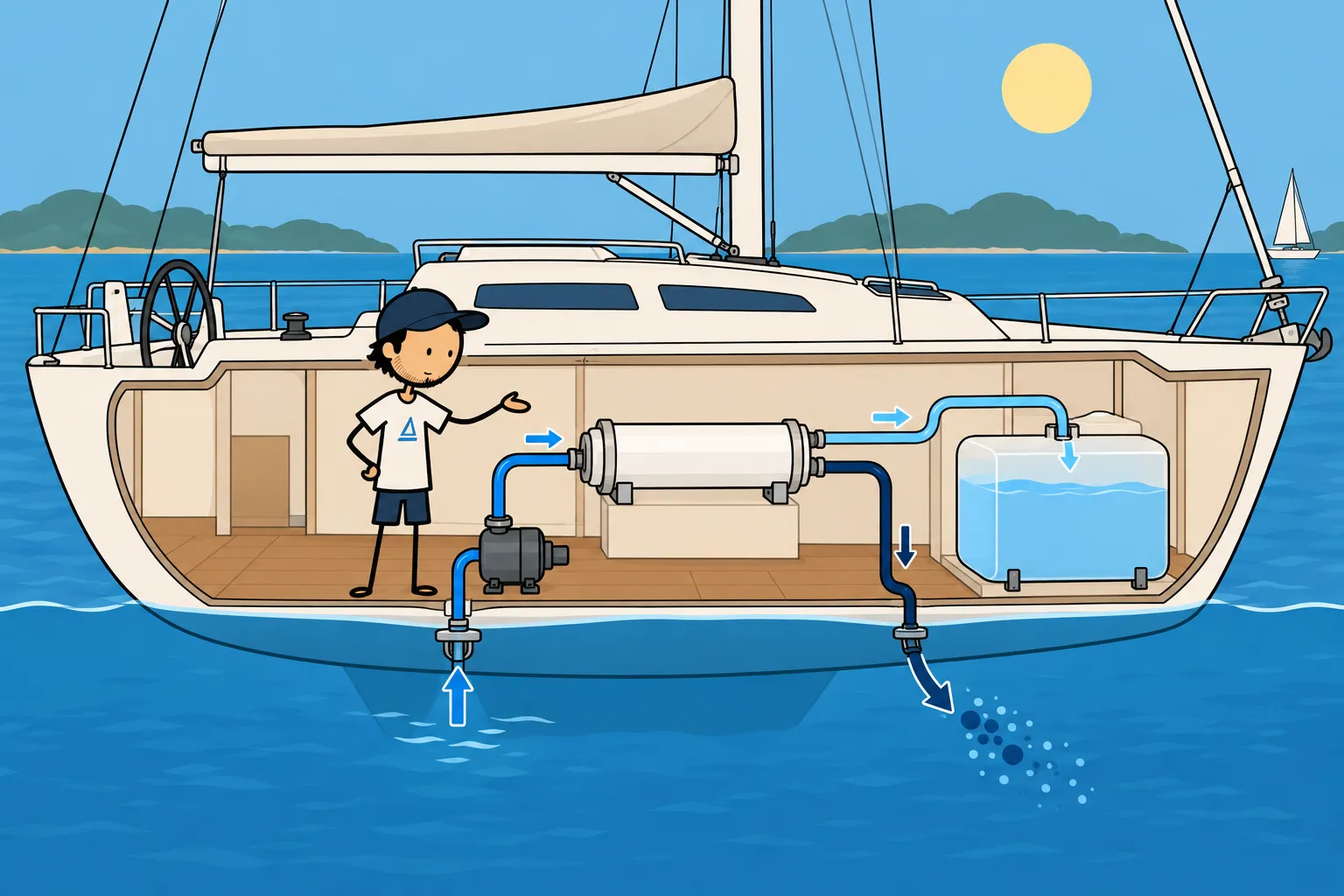
Most yacht watermakers work by reverse osmosis. In plain words: a very fine filter with a lot of pressure behind it.
- Seawater comes in through an opening in the hull and passes through pre-filters that catch sand, plankton and dirt.
- A high-pressure pump, similar to a pressure washer, pushes it against a membrane, at around 40 to 65 bar depending on the system.
- The membrane lets the water through and holds back the salt. Its pores are smaller than salt molecules, and even smaller than bacteria. Manufacturers quote more than 99% of the salt removed.
- The fresh water goes to the tank. The rest of the seawater, now saltier, goes back into the sea.
Why "reverse"? In ordinary osmosis, fresh water moves through a membrane like this towards the salty side, on its own. Push the salty side hard enough and the flow goes the other way.
As for how much water: watermakers built for sailboats and catamarans typically make around 30 to 150 litres an hour, depending on the model. Schenker recommends choosing one that covers the boat's daily needs in about 3 to 4 hours of running.
When and where does a watermaker run?
- It needs electricity. Smaller watermakers run on the boat's 12V or 24V batteries, which the engine then recharges. Bigger ones run on 220V, which away from the harbour comes from a generator, on boats that have one.
- It needs clean, open water. That means at anchor in a clear bay, or under way. Harbour water is muddier and can carry traces of oil and fuel. The manufacturer Spectra warns that silt damages the pumps and membranes, and that oil can ruin a membrane for good.
- It isn't needed in a harbour anyway. There, the tanks are filled from the quay.
- It's the skipper's call. The skipper is responsible for the boat, so when and where to run the watermaker is part of that job.
What changes on a sailing week with a watermaker?

- More nights at anchor in a row. Without a watermaker, the tanks decide when it's time for a harbour. With one, the boat can stay longer in quiet bays. Schenker puts it simply: a watermaker increases the time and distance a boat can cover between harbours.
- Longer showers. It's still not a hotel bathroom, but you don't have to count every litre either.
- Less dependence on harbour water, which helps on islands where water is scarce in summer.
- What stays the same: the tanks are the same size, hot water still comes from the engine, from shore power in a harbour, or from the generator on boats that have one, and a harbour stop is still nice for groceries, fuel and dinner on shore. The route is still the skipper's proposal, put together around the weather conditions and your wishes. The watermaker just gives it more freedom.
Can you drink water from a watermaker?
The water that comes out of the membrane is very clean, but manufacturers don't agree on drinking it straight from the boat's tap:
- Spectra says desalinated water is safe to drink, and that its membranes remove 99.5% of dissolved solids.
- Dessalator describes the water it makes as essentially sterile, and advises treating the water stored in the tank from time to time.
- Schenker says its water is very pure, but since drinking water can't be certified on a boat, it should be considered fit for washing and hygiene only.
The weak point is the tank. Water from the watermaker ends up in the same tank as water from the harbour, and it can sit there for days. That's why, watermaker or not, we drink bottled water on a sailing week, bought with the groceries, and use the tank water for showers and washing up.
Which boats have a watermaker?
A watermaker is extra equipment, not a standard part of every charter boat. You'll find it more often on bigger, better-equipped boats, especially catamarans, where it often comes together with a generator and air conditioning. Many sailboats don't have one, which is why our route pages say fresh water is limited without it.
In charter listings it appears in the boat's equipment, and some boats even carry it in their name, like "Lagoon 42 (AC, Gen, Watermaker)". Whether a particular boat has one depends on the boat: check its details in our yacht catalogue, or ask us.
Frequently asked questions
1Does a watermaker mean unlimited water?
2Can the watermaker run in a harbour?
3Is the water from a watermaker hot?
4Do I have to do anything with the watermaker?
5Can I ask for a boat with a watermaker?
Your week
Want more nights at anchor?
Tell us your dates, your group size and what matters most to you on board. Send us an inquiry and we'll get back to you.