Boat generator - what it is and when you really need one
What a boat generator is, what it powers at anchor, how it differs from an inverter, how to use it in a quiet bay, and whether it costs extra on a charter.

In the equipment list of many catamarans you'll see the word "generator". What does it mean for your week at sea? In short: 220V power even when the boat isn't in a harbour.
If you've read about life on board, you know the basic rule: you can charge your phone any time, but the normal sockets work only when the boat is plugged in at a harbour. A generator is the exception to that rule. Here's how power works on a boat, what changes when the boat has a generator, and what to keep in mind.
How does power work on a boat without a generator?
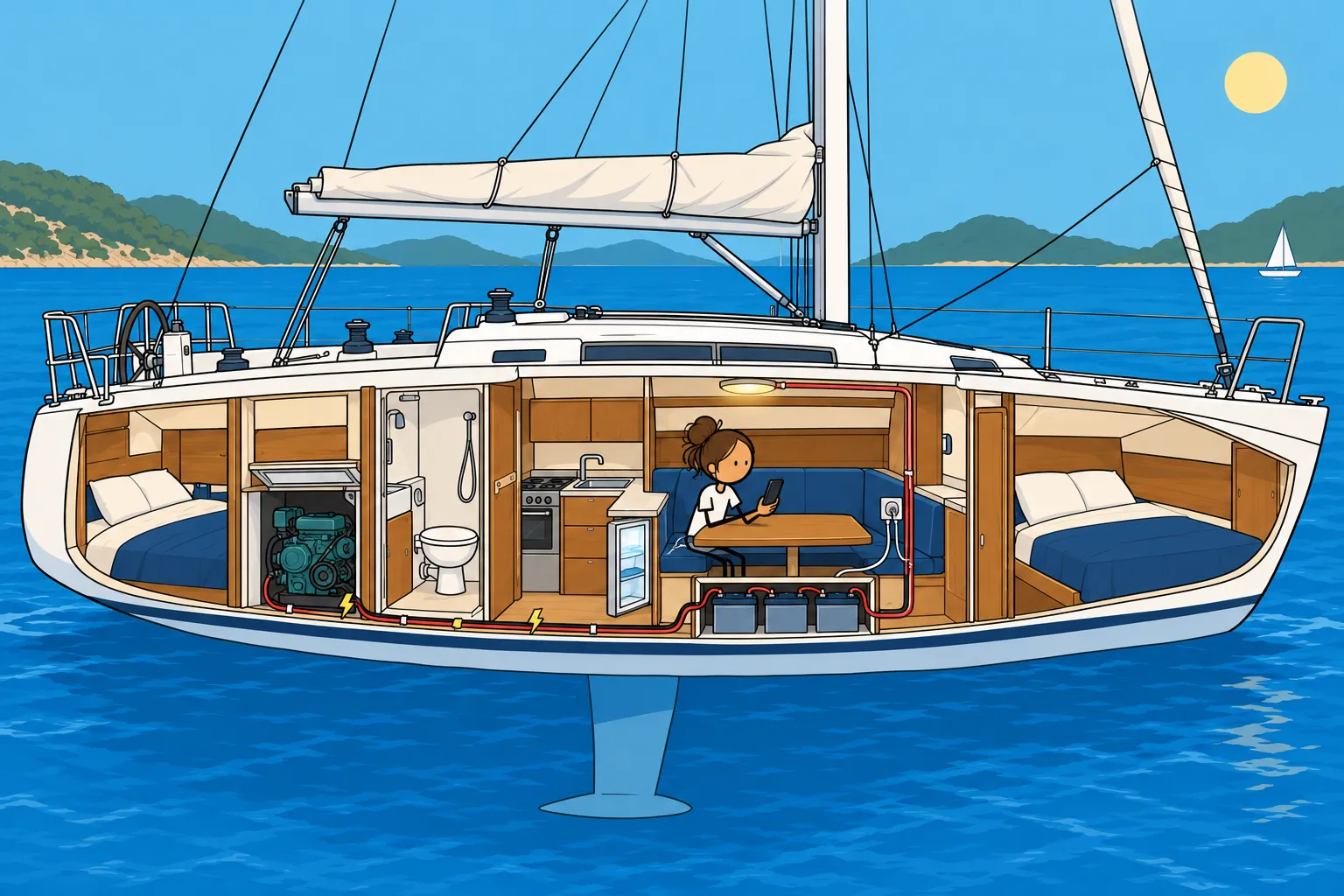
The boat runs on 12-volt batteries, like a camper van. They charge while the engine runs and when we plug into shore power at a marina or town quay.
- Phones, cameras and laptops charge any time, through USB or car-type 12V sockets.
- The fridge, lights and water pumps run on the batteries.
- Normal 220V sockets work only when the boat is plugged in on shore.
- Hot water is heated by the engine and, in harbours, by shore power.
For a sailing week that's plenty: your phone is charged, the fridge stays cold, and the hair dryer waits for a harbour night.
What is a boat generator?
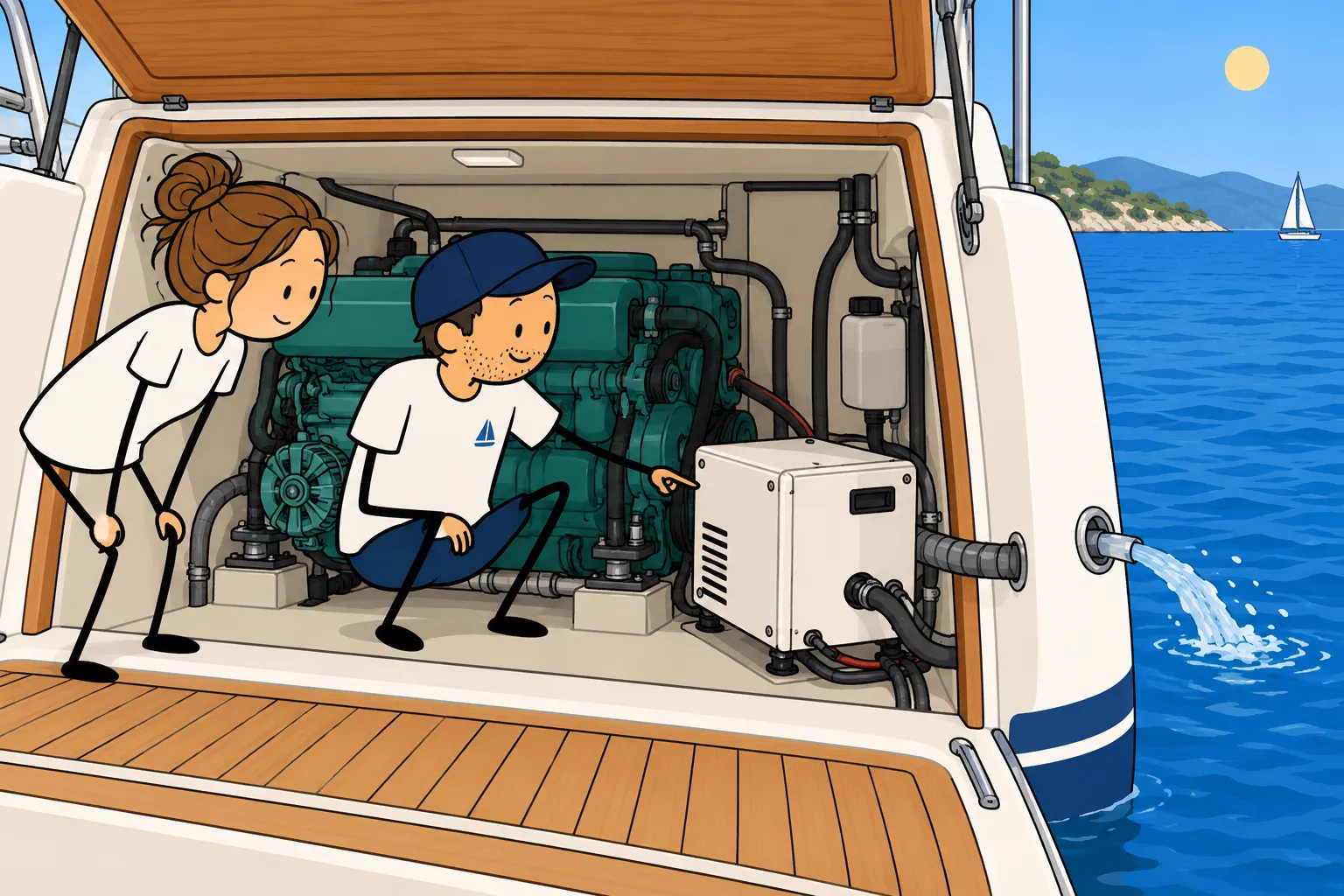
A generator is a small diesel engine connected to an alternator that makes 220V electricity, the same power the boat gets from shore. It sits in the engine room inside a sound-insulated box, is cooled by water and has its own exhaust through the hull.
For guests, the key point is this: the generator runs separately from the engine that moves the boat. The boat can sit quietly at anchor in a bay while the generator supplies power for things that normally only work in a marina. When it's switched off, the boat goes back to its batteries.
What changes when the boat has a generator?
While the generator runs, the boat at anchor has power as if it were in a harbour. In practice, that means:
- Air conditioning at anchor. On boats that have it, the air conditioning runs on shore power in a marina, and at anchor only with the generator. The batteries can't run it for long.
- Charging the batteries. The generator runs the battery charger, so the batteries fill up without long hours of engine running.
- Fresh water from the sea. A watermaker, the machine that turns seawater into fresh water, runs on 220V on many boats, so it's switched on while the generator runs.
- Hair dryers and straighteners work at anchor too, not only in a harbour.
- Hot water without motoring. On many boats the water heater has an electric element that works on shore power, so it also heats water while the generator runs.
- A microwave, electric oven or hob, where the boat has one.
There's one limit: a generator has only so much power. While the air conditioning is on, switch the bigger loads, like a hair dryer or a kettle, on one at a time rather than all at once.
What is an inverter, and how is it different from a generator?
An inverter is a device that turns 12V power from the batteries into 220V. Thanks to it, a 220V socket can work away from the harbour, with one important difference: an inverter doesn't make power, it uses what's already in the batteries.
- Great for small devices: a laptop, a camera or drone charger. It's silent and has no exhaust.
- Not for big loads: a hair dryer, a kettle or air conditioning drains the batteries quickly, and a small inverter can't run them at all.
- The batteries then need recharging, by the engine, shore power or a generator.
- The inverter socket is usually labelled separately, so not every socket on the boat works the same way.
In short, a generator is a small power station on board, while an inverter is a converter that spends what's already stored. If a boat's description says "inverter", that doesn't mean you can use a hair dryer or air conditioning at anchor.
How do you use a generator in a quiet anchorage?

A generator isn't silent like an inverter. Even inside its sound-insulated box, you hear the engine and the splash of water from the exhaust, and in a calm bay sound carries far across the water. The people on the boats next to you came for the peace and quiet too, so a few rules of good manners apply:
- Sensible hours. Run the generator during the day, when the bay is lively anyway, not late in the evening or early in the morning.
- Cool down, then switch off. You can cool the cabins before bedtime and switch the generator off before everyone goes to sleep. At anchor there's almost always a breeze at night, and with the hatches open the cabins stay pleasant.
- Agree on it with the skipper. The skipper is responsible for the boat, so agree together when the generator runs and what gets switched on while it does.
- The exhaust is no place for a swim. Like the engine, a generator gives off exhaust gases with carbon monoxide, which has no colour and no smell. While it runs, don't swim or sit near the exhaust. Ask the skipper where it is.
Which boats have a generator, and does it cost extra?
A generator is the exception, not the rule. You'll find one most often on catamarans, especially the larger ones, usually together with air conditioning and a watermaker. On charter sailboats it's less common, so there the rule is that 220V works only in a harbour.
Equipment varies even between boats of the same model, because it depends on what was fitted to that particular boat. Whether a boat has a generator, air conditioning or a watermaker is listed in the boat's details and in your offer, and you can always ask us.
Like a lot of what goes into the cost of sailing, paying for the generator depends on the boat. On some boats generator use is charged per running hour, sometimes with a few hours a day included. The rules differ from boat to boat, so check the boat's details or ask us before you book.
Frequently asked questions
1Does every catamaran have a generator?
2Can I use a hair dryer at anchor?
3Is the generator the same as the boat's engine?
4Can the generator run all night?
5Do I need a generator to charge my phone?
Your week
Not sure whether you need a boat with a generator?
If you're sailing in July or August and air conditioning at anchor matters to you, a generator makes a difference. If a breeze through an open hatch is enough, you'll be fine without one. Tell us what matters to you, and we'll get back to you with boats that fit.