Sailing with a dog - can your pet come on a sailing week?
Can you bring your dog on a sailing week in Greece? Owner's rules, EU entry rules for non-EU travellers, heat, water, going ashore and a life jacket.

Many people hesitate to book a sailing week because they don't want to leave the dog at home. The honest answer to whether yours can come is: it depends on the boat. A charter boat belongs to an owner, and the owner decides whether animals are allowed on it.
So the first step is a question, not a plan. If the answer is yes, there are two more things to sort out: the paperwork to bring a dog into Greece, and the daily practicalities of a dog on a boat, from heat to going ashore.
Is a dog allowed on a charter boat?
It depends on the boat owner's rules, and the rules differ from boat to boat. Some owners allow pets, some don't, and some set conditions, such as a cleaning fee or limits on where the dog can be on board. An extra fee may apply.
There is no single answer for every boat. If you want to travel with a dog, ask whether pets are allowed on the boat you like, before you book. Don't buy anything for the dog, or book transport, until you have that answer in writing.
Dogs on sailing boats aren't unusual in Greece. A sailing guide notes that a yacht with a dog (or dogs) turns up in a harbour from time to time, and describes a cat on board that went ashore on a harness and leash.
What do you need to bring a dog into Greece?
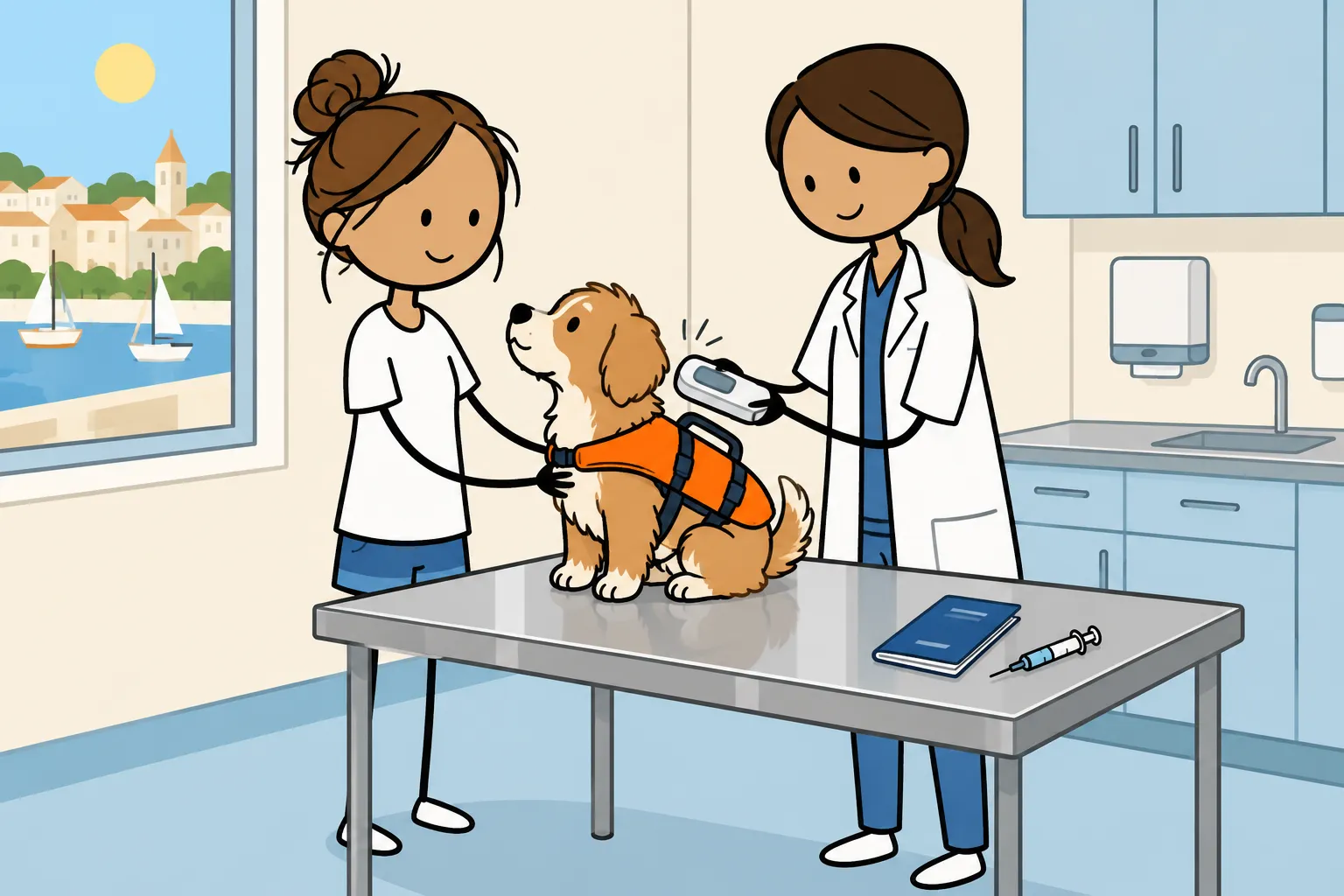
Greece is in the EU, so the EU rules for pets apply. They depend on where the dog is travelling from. The European Commission lists these basics for a dog coming from outside the EU:
- Microchip. The dog must be identified by a microchip.
- Rabies vaccination. The dog must be at least 12 weeks old when vaccinated, and the vaccination counts from 21 days after the primary vaccination is completed.
- Animal health certificate. An official vet in the departure country issues it, and it is valid for 10 days from issue. For sea transport the 10 days are extended by the length of the sea journey.
- A designated point of entry. Dogs from most non-EU countries must come in through a designated travellers' point of entry.
- Number of pets. Up to 5 dogs, cats or ferrets travelling for non-commercial reasons.
These are the general rules. The next section covers the part guests from outside the EU ask about most.
What about a dog travelling from a non-EU country?
If your dog travels from outside the EU, the rules for non-EU countries apply: microchip, rabies vaccination, an animal health certificate and a designated entry point. A pet passport alone does not replace the certificate for a dog from a non-EU country.
The rabies antibody (titre) test is the extra step that worries people. For dogs from countries not on the exempt list, the blood sample is taken at least 30 days after the primary vaccination and at least 90 days before the certificate is issued, with a result of at least 0.5 IU/ml from a designated laboratory. According to the Commission's page, some non-EU countries are on the list of countries exempt from the titre test, so check whether yours is one of them. The lists are updated, so check the current rules with your vet or the veterinary authority before you plan the timing.
Two practical points. First, start early: the vaccination, the certificate and the entry-point route are the things that can't be done at the last minute. Second, a few EU countries and Norway require a tapeworm treatment, but Greece is not among them. Your own vet can confirm all of this for your dog and your travel dates.
Don't use older articles for the timing. Some guides still quote entry rules (for example, certificates "not less than 6 days before arrival") that no longer match the current EU regulation.
What is it like for a dog on a boat in Greece?

Think of it as a week in a small, hot, moving flat.
- Heat. July and August are hot, and a deck under the sun heats up fast. Shade and a place to rest below deck matter, and so do early morning and evening walks ashore.
- Fresh water. Water on board is limited, held in tanks of a few hundred litres and refilled in harbours every day or two. Plan for the dog's drinking water on top of the crew's. Rinsing a dog with salt on its coat takes fresh water too.
- Toilet. A dog needs to go ashore, so plan the day around harbours and beaches, not only quiet bays. In some anchorages going ashore means a dinghy ride.
- Noise and movement. Engines, flapping sails and a boat that moves under the paws are new for most dogs. Some dogs love it, others get anxious or seasick (see our piece on seasickness).
How do you get a dog ashore and keep it safe?

A dog life jacket is a good idea for any dog on a boat. A dog that falls overboard has no ladder to climb, and a jacket with a handle on the back lets you lift it back on deck. Let it wear the jacket at home first, so it isn't a surprise on day one.
Going ashore from an anchorage means a dinghy, with the dog in a jacket and on a short lead. In harbours the boat is moored stern-to the quay, so the dog may step across a gangway. Keep it on a lead, and keep it away from the stern when the anchor is working and when the lines are being handled.
On shore, rules change from place to place. Some beaches and taverna terraces welcome dogs and others don't, so look for signs and ask.
How do you plan the week with a dog?
A few ideas that make the week easier:
- Tell the skipper in advance. The skipper runs the boat and decides where it stops, so a dog's needs belong in that early conversation. The route is the skipper's proposal, put together around the weather and the guests' wishes.
- Think about the other guests. Allergies, fear of dogs and bed sharing are worth settling before you board, not after.
- Pack for the dog. Food for the whole week, a bowl that doesn't slide, a lead and harness, a non-slip mat, a towel, and bags. A pet shop on the first island is not a certainty.
- Choose a boat with space. A catamaran has its saloon and cockpit on the same level, which many dog owners find easier than steps down to a saloon. Check the boat owner's rules first.
Frequently asked questions
1Can I take my dog on a sailing week?
2Do I need a pet passport for Greece?
3Do I need a rabies titre test coming from a non-EU country?
4Is it safe for a dog on a boat?
5Does a dog need its own life jacket?
Your week
Planning a week with your dog?
Mention the dog's size and what you need in your question about a boat.