Sailing vs cruise - two very different ways to spend a week at sea
A boat just for your crew or a floating town? We compare a sailing week and a cruise on route, coves vs ports, crowds, food, comfort and cost, fairly.
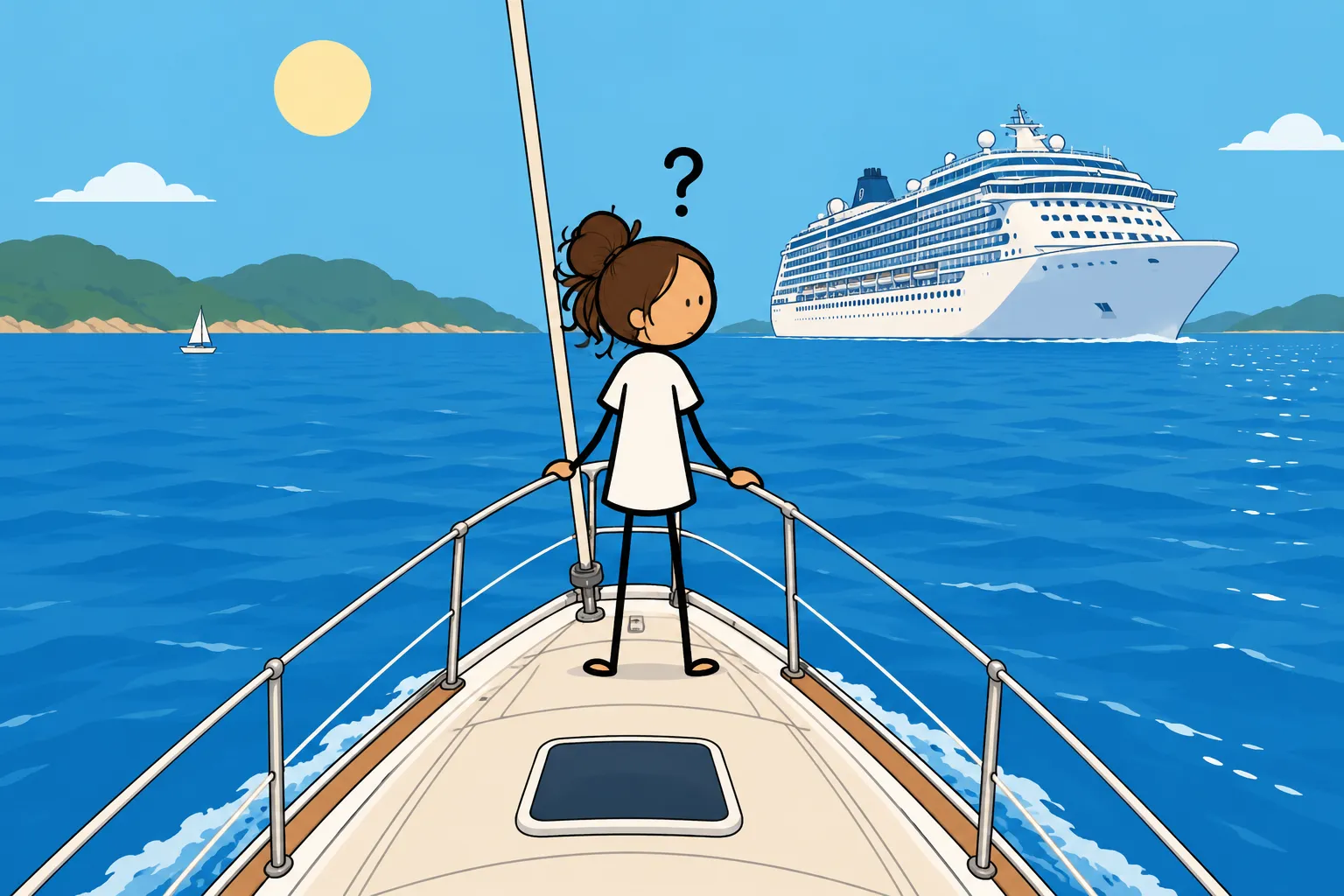
Sailing or a cruise? Both are holidays on the water: you wake up somewhere new every morning and see more islands in a week than from one apartment. Cruising is hugely popular: according to the industry association CLIA, 34.6 million people took an ocean cruise in 2024.
Many people still picture sailing as complicated and expensive, something for those who already know how to sail. On a skippered week that isn't the case: the skipper runs the boat, so sailing without experience is completely normal. When we say cruise here, we mean a holiday on a big passenger cruise ship, not cruising on a sailboat.
The short answer: a cruise is a big hotel that sails from city to city, with every meal and all the entertainment on board. Sailing in Greece or Croatia means a small boat just for your crew, stopping in coves and small harbours. Below we compare the two fairly: a cruise isn't a bad choice, just a different holiday.
What's the basic difference between sailing and a cruise?
It comes down to the size of the boat and who you share it with. A cruise ship is a shared ship for thousands of people, on a route set in advance. A sailboat or catamaran is a boat just for you, with a skipper who lives on board with you all week.
Every other difference follows from that:
- Who's on board: on a sailing week, your crew, usually at most 11 guests plus the skipper; on a cruise, several thousand passengers and the crew.
- Route: on a sailing week, the skipper proposes it, around the weather and your wishes; on a cruise, set in advance, with fixed times in port.
- Where you stop: on a sailing week, coves, small villages and island harbours; on a cruise, bigger ports and well-known cities.
- Food: on a sailing week, on board, at anchor and in tavernas; on a cruise, meals on board included in the fare.
- Cabin: on a sailing week, smaller, with no air conditioning on most sailboats; on a cruise, a private bathroom, air conditioning and daily housekeeping.
- Cost: on a sailing week, the boat's price is shared by the whole crew; on a cruise, priced per person, extras on top.
How many people are on board with you?
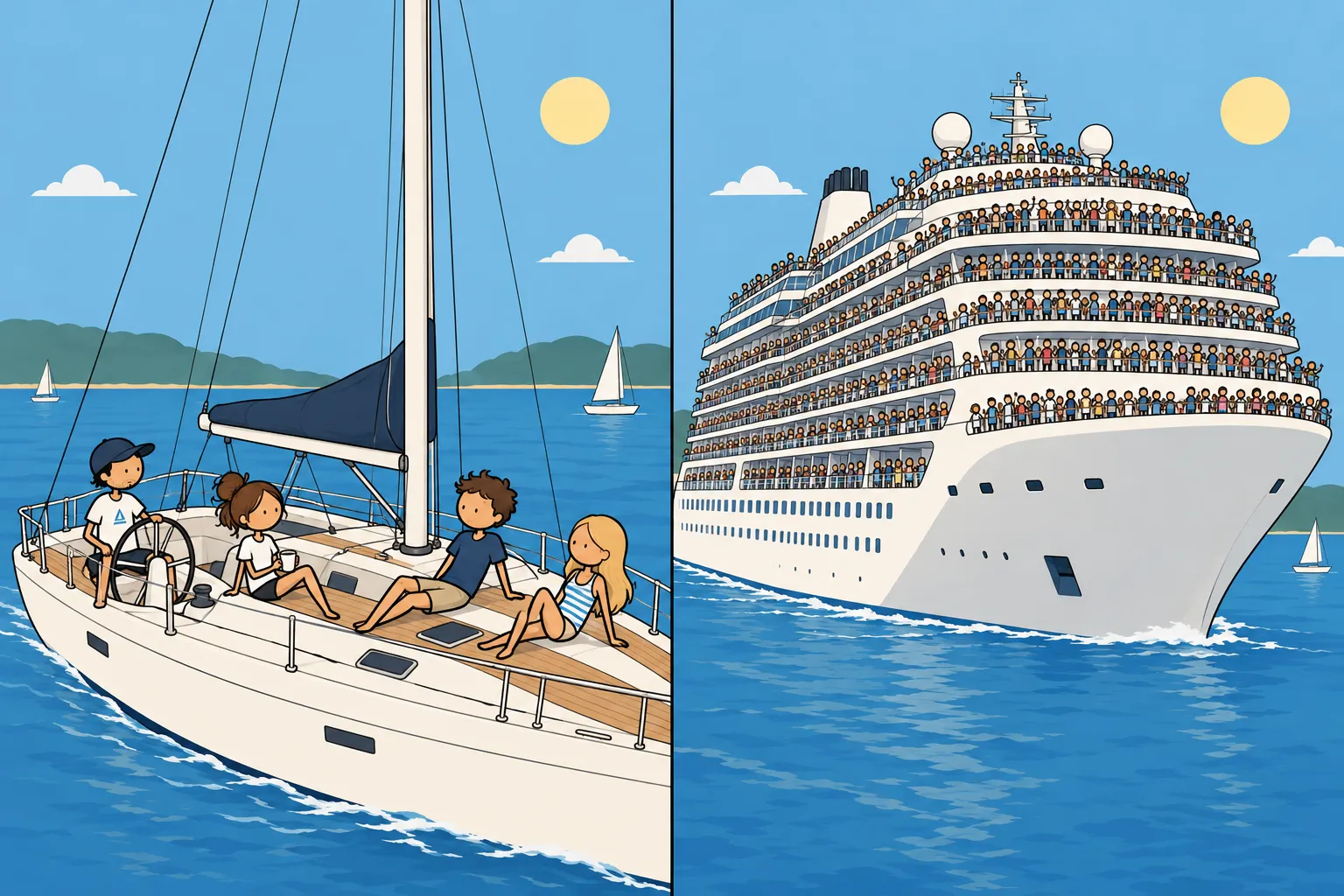
On a cruise you're part of a big floating town. Large cruise ships take several thousand passengers, and the biggest in the world, Icon of the Seas, up to 7,600. That has its upsides: pools, shows, restaurants, lots of new people and always something to do.
On a sailing week it's just your group on board: usually at most 11 guests plus the skipper, whatever the number of berths, and the skipper and a hostess count towards each boat's own maximum. Cabins usually sleep two, on a double bed or two separate beds. You know everyone you share the deck with, you pick the music, and nobody takes your spot in the sun.
That's why sailing suits friends, families and teams who want to be together. If you like meeting new people every evening, you'll find more of them on a cruise.
Who decides the route, and how free are you?
This is the difference you'll feel most during the week.
- A cruise runs to a timetable. The route and the arrival and departure times for every port are known in advance. Explore a town on your own and you must be back on time: Royal Caribbean, for one, states that the ship won't wait for guests touring on their own.
- On a sailing week the skipper proposes the route and puts it together around the weather conditions and the guests' wishes. Fall for a cove? Tell the skipper, who judges whether you can stay longer.
- Sailing has a frame too. The week runs Saturday to Saturday, and the boat returns to the base marina by 18:00 on Friday, so the route has to lead back. In bad weather the plan changes or the boat waits in a safe harbour.
Coves or big ports, and how crowded is it?
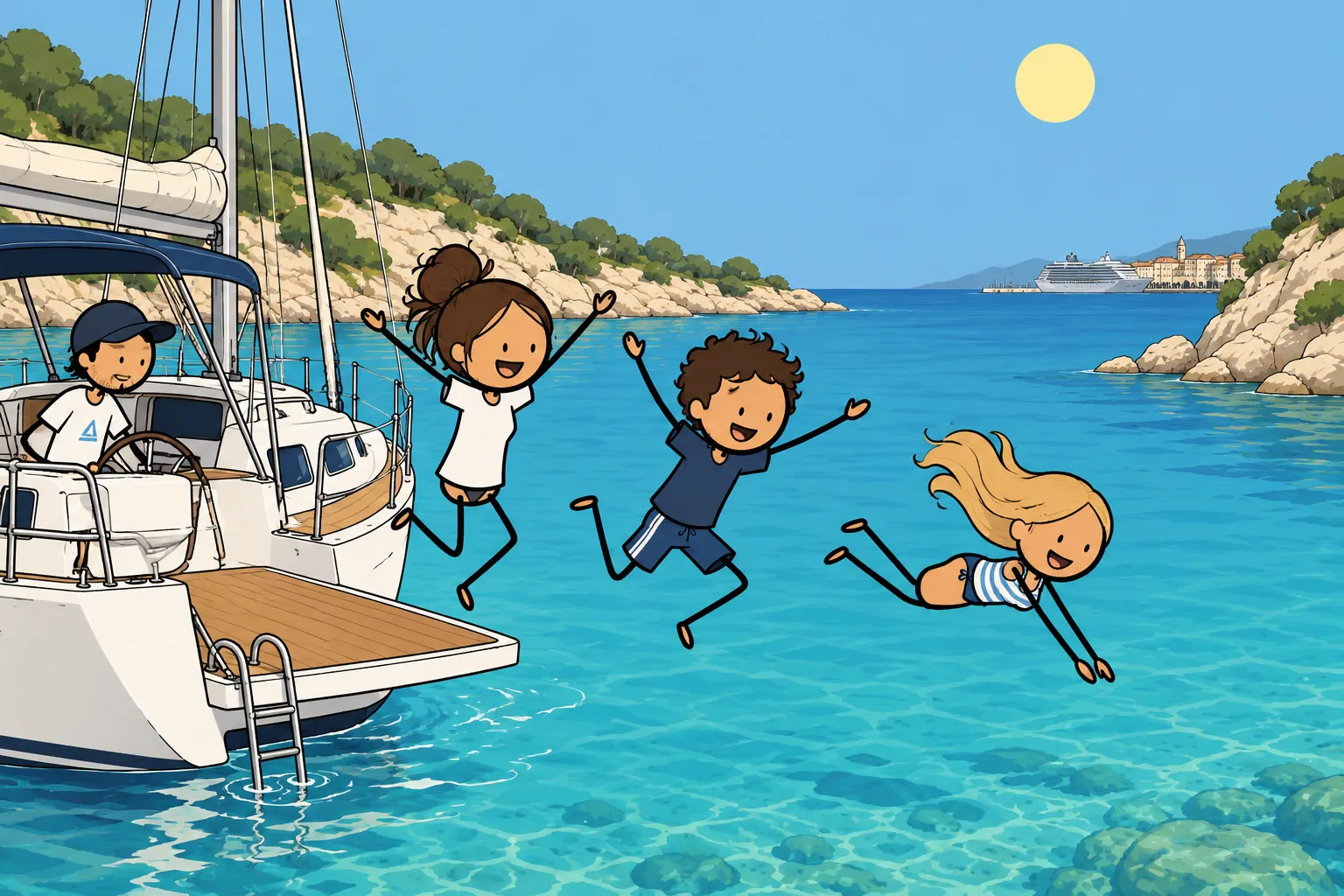
A cruise ship can only stop where there's room for a ship that size, so the route is built around famous cities and the best-known islands. Those islands are also the most crowded. Santorini received 800 cruise ships with nearly 1.3 million passengers in 2023, and on peak days up to 17,000 people come ashore from the ships. That's why in 2025 Greece introduced a 20 euro fee per cruise passenger in high season on Santorini and Mykonos.
A sailboat stops where a cruise ship can't:
- Coves you can only reach by sea. The boat drops anchor and you jump into the sea straight off the stern, before breakfast or after lunch.
- Small island villages. In the evening the boat moors on the quay, a few steps from the taverna.
- Calmer seas to start with. Sailing the Ionian Sea, for example, means calmer water and short legs, which makes it a great choice for a first time.
To be fair, sailing isn't crowd-free either. In July and August harbours fill up with sailboats too, so it pays to arrive early in the afternoon, and in the prettiest coves you'll rarely be alone. Still, sharing a bay with a few sailboats is nothing like sharing a street with thousands of cruise passengers.
How do you eat on a sailing week compared with a cruise?
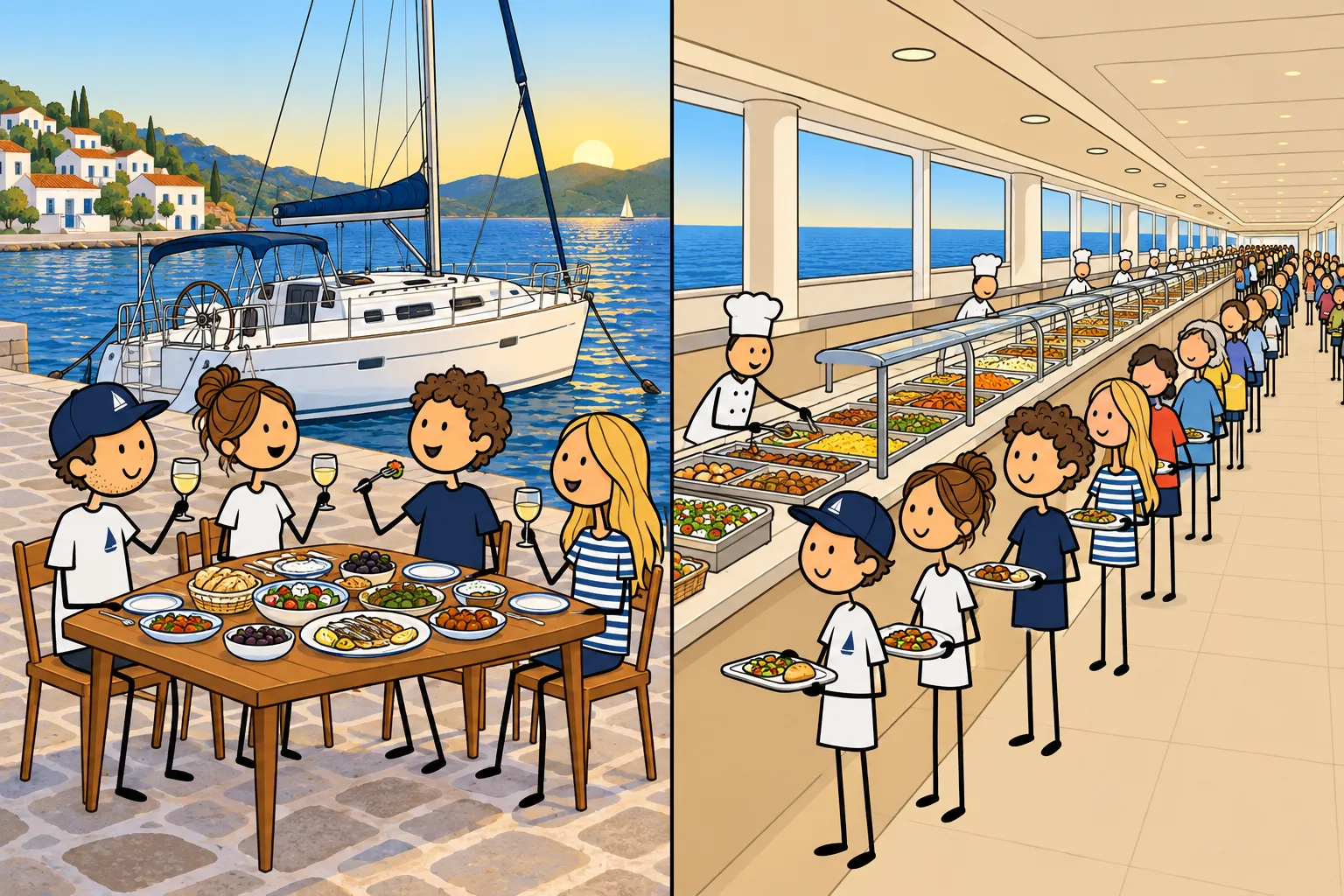
On a cruise, food is part of the fare. With Royal Caribbean, for example, the main dining room, the buffet and several other venues are included, along with water, tea, coffee and some juices, while drinks packages and specialty restaurants cost extra. You don't have to think about any of it.
On a sailing week you eat however the crew decides. A typical day looks like this: breakfast on the boat or in the marina, lunch at anchor after a swim in a cove, and dinner at a restaurant on the island or on board. The crew buys the groceries, in shops and markets along the way, and the crew also covers the skipper's food: what you eat, the skipper eats.
If you'd rather not cook or tidy up at all, you can also book a hostess. She helps the skipper, keeps the boat clean and prepares the meals, which is why we recommend her for a holiday with no obligations at all.
What does it feel like, and how comfortable is it?
On a cruise you're a passenger. You watch the sea from a high deck and someone else takes care of everything else. Your cabin has its own bathroom and air conditioning and is cleaned every day. A big ship also moves less on the waves than a small sailboat, which matters a lot to anyone prone to seasickness.
On a sailboat you're closer to the sea and part of the crew. You hear the wind once the engine is off, you feel the boat pick up speed, and if you want, you can usually try the helm with the skipper. In some harbours guests help with the lines when mooring, which is basic, needs no prior knowledge, and the skipper explains it at the start of every week.
Life on board a sailboat is simpler than on a cruise ship, and it's good to know that in advance:
- cabins are smaller, and on many sailboats two cabins share one bathroom
- most sailboats have no air conditioning
- fresh water is limited, so showers are quick, and the tanks are refilled in harbours every day or two
- 220V power is available when the boat is plugged in at a harbour, or at anchor while the generator runs on boats that have one, and phones charge from USB sockets
If you want more space and sailing without heeling, a catamaran is the answer: it sails flat and has far more room than a sailboat.
Is sailing more expensive than a cruise?
Not necessarily. They're hard to compare with one number, because the price is worked out in completely different ways.
- A cruise is priced per person. The fare usually covers the cabin, meals and entertainment on board. Excursions, drinks, Wi-Fi and specialty restaurants are paid separately.
- A sailing week is priced per boat, and the whole crew shares the boat's price. The boat comes with a yacht package: bed linen, towels and the final cleaning. Food and drinks, fuel, and marina and port fees aren't in the boat price and are paid during the week.
So with sailing, a lot depends on how many of you there are: the fuller the boat, the lower the price per person. The overall cost of sailing in Greece depends on the dates, the destination and the boat, and a cruise on the line, the cabin and the season. Sailing isn't just for the rich: split across a full boat, the cost per person is far lower than people expect when they hear what the whole yacht costs.
Who is a cruise better for, and who is sailing better for?
There's no wrong choice. It's only a question of what kind of holiday you're after.
A cruise is the better choice if...
- you want to see several famous cities in one week and organise nothing
- you want meals, entertainment and kids' programmes already in the price
- you need a lift, a roomy cabin with its own bathroom, and air conditioning
- seasickness really bothers you
- you love a big ship, shows and meeting new people
Sailing is the better choice if...
- you're travelling with friends, family or a team and want a boat to yourselves
- you care more about swimming in coves and small villages than big ports
- you want a route that leaves room for changes
- you want to feel the wind and the sea, not just look at them from a deck
- there are enough of you to fill the boat, so the price splits nicely
Frequently asked questions
1Do I need sailing experience?
2How long is a sailing week?
3Is seasickness worse on a sailboat than on a cruise ship?
4Do we have to cook on board ourselves?
Your week
Fancy a week on a sailboat instead of a cruise ship?
Tell us how many of you there are, when you'd like to sail and what your budget is, and we'll suggest boats that suit you, both sailboats and catamarans.