Cooking on a Boat - what the galley looks like and what's in it
What a boat galley looks like: gas stove and oven, 12V fridge, sink and water, plates and cutlery, cooking at anchor and one-pot dishes that are easy to make.

When someone plans their first sailing week, after the questions about cabins and the toilet this one usually follows: how do you cook on a boat? Many picture a camping stove and tins. A boat galley is actually a real small kitchen, with a stove, oven, fridge, sink, crockery and cutlery.
It's smaller than at home and works a little differently: gas comes from a cylinder, the fridge runs on batteries, and water comes from a tank. What to buy and how many meals to eat on board versus in tavernas is a separate topic, covered in our piece on meals on a sailing week.
What does a boat galley look like?
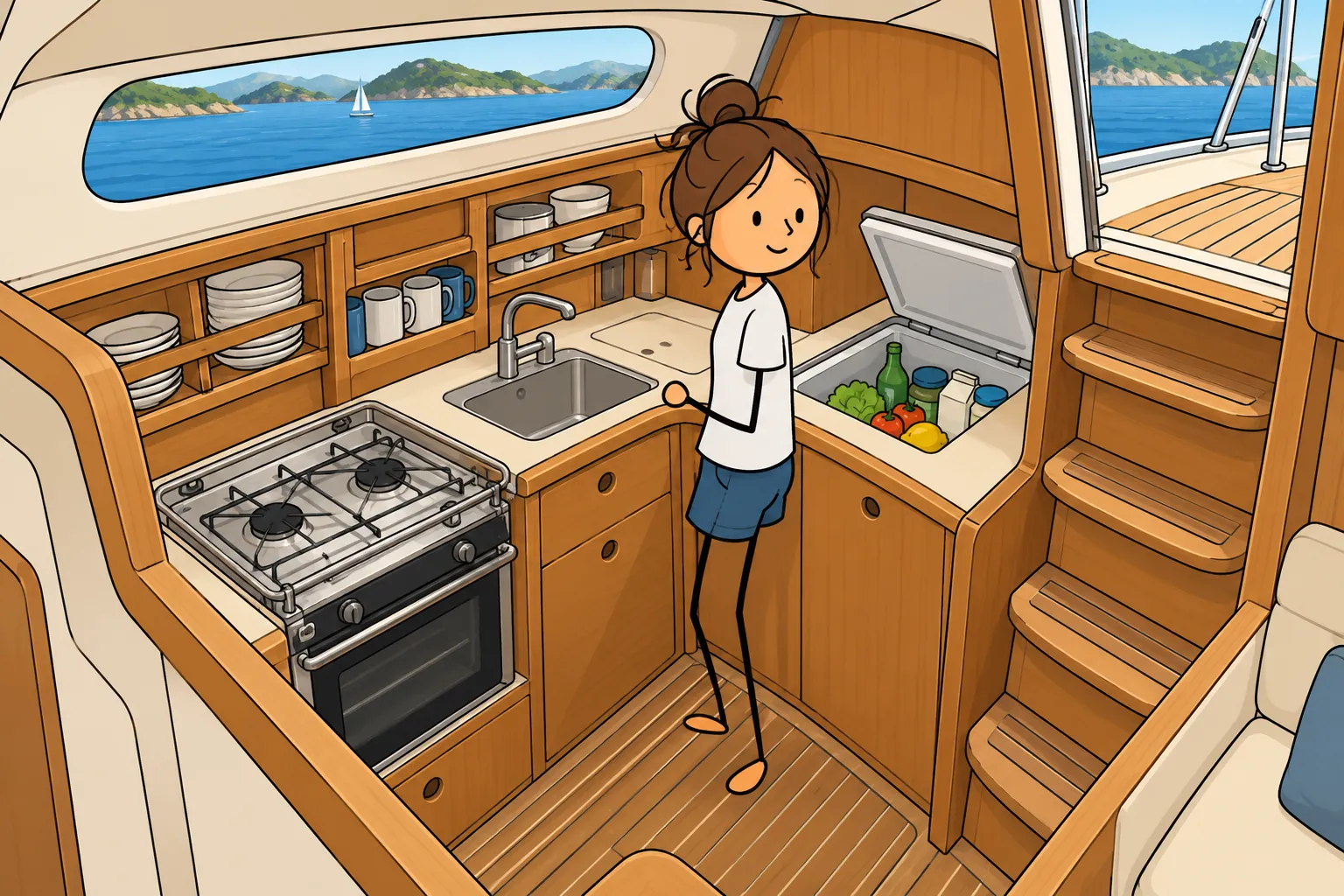
On a sailboat the galley is below deck in the saloon, usually next to the steps from the cockpit. On a catamaran it's in the saloon, level with the cockpit, so whoever is cooking stays part of the group.
The galley of a typical charter boat has:
- A gas stove, on many boats with an oven underneath. Sailboats usually have two burners, larger boats and catamarans three.
- A 12V fridge. Larger catamarans often have two fridges and a freezer.
- A sink with hot and cold water, pumped from the tank.
- Crockery, pots and cutlery for the whole crew.
A microwave or electric hob exists only on some boats and runs on 220V, so only on shore power. That's why cooking on a boat means cooking on gas.
What exactly the galley has depends on the boat, even among the same models. You can look at boats in the yacht catalogue, and if an oven or a bigger fridge matters to you, check the boat's description before booking.
How do you use the gas stove and oven?
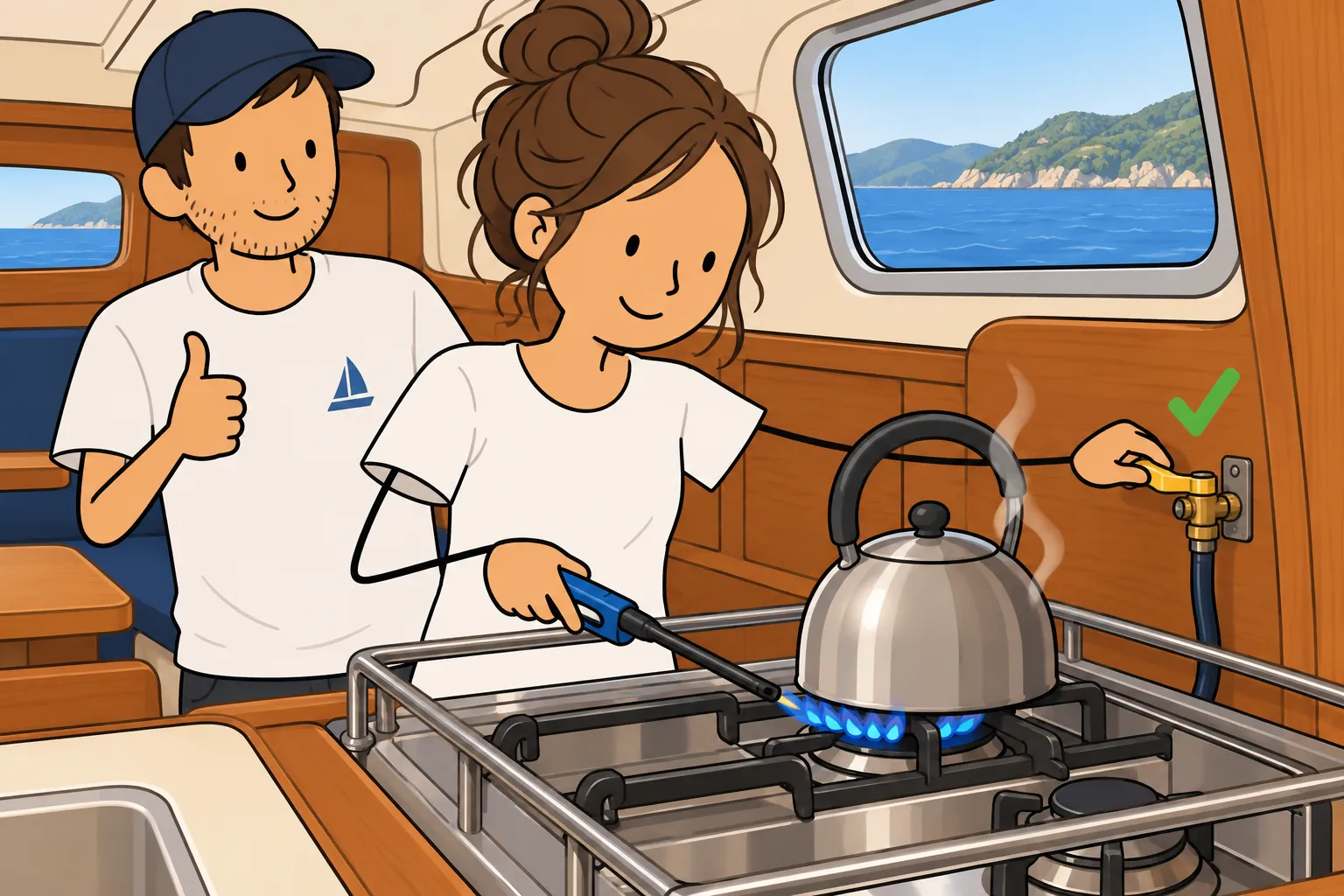
The gas is in a cylinder, kept in a dedicated locker on deck. The locker drains overboard, so if gas ever leaks it doesn't stay in the boat. Many boats also have a gas valve in the galley, which turns the gas on and off without going to the cylinder.
The skipper shows everyone how to light and turn off the stove. The steps are usually these:
- 1. Open the gas, at the valve in the galley or at the cylinder.
- 2. Press and turn the burner knob, then light it with a lighter or match.
- 3. Keep the knob pressed for a few more seconds. Many boat stoves have a safety device that lets gas through only while the flame heats a sensor, so if you let go too early the flame goes out.
- 4. When you finish, turn off the burner and close the gas. Gas closed whenever you're not cooking is the safest habit on a boat.
The oven runs on the same gas and lights similarly, but each model is a little different, so ask the skipper to show you that too. It's smaller than a home oven and heats the galley quickly in summer, so evening is the pleasant time for it.
What if you smell gas?
Gas is heavier than air. If it leaks, it sinks and collects at the lowest point in the boat, under the floor. So:
- close the gas at the valve or the cylinder
- put out every flame and don't touch electrical switches
- open all hatches and windows to ventilate the boat
- tell the skipper at once, and don't use the stove until the installation is checked
How does a fridge work on a boat?
The fridge runs on 12V batteries, like the lights and water pumps, so it keeps cooling at anchor. The batteries charge while the engine runs and when the boat is on shore power in a harbour. Every opening lets the cold out and the fridge uses power to win it back, so keeping it shut matters more on a boat than at home.
- On many sailboats it opens from the top, through the worktop, like a chest. Nothing falls out when the boat heels, and the cold air stays in.
- It's smaller than at home, so top up fresh food on the way.
- Open it briefly. Know what you're taking before you open it, and keep what you reach for most on top.
- Food spoils fast in the heat. Perishables shouldn't sit outside the fridge for more than two hours, or one hour when it's above 32°C. After lunch in the cockpit, put leftovers straight back.
Is there enough crockery and cutlery on board?
Yes. A charter boat comes with an equipped galley: plates, glasses, cups, cutlery, pots and pans. A few tips still help:
- On day one, see what's there before the big shop, so you don't buy what already exists.
- Bring what you can't do without. If a good knife or your favourite coffee pot matters, bring it.
- You buy consumables yourself. Dish soap, sponges, cloths, bin bags, salt, oil, spices and matches usually aren't on board, or only a little.
Final cleaning at the end of the week is part of the yacht package. During the week the crew looks after the galley and the washing up, unless you book a hostess alongside the skipper, who prepares meals and cleans.
How do you wash up and save water?
Sink water comes from the same tanks as the shower. The tanks hold a few hundred litres, so water is used sensibly in the galley too.
- Don't let the tap run. Fill one side of the sink or a basin, wash everything at once, then rinse briefly.
- Wipe greasy pans with paper first, so they need less water.
- In a clean cove the sea helps. You can wash pots and plates in seawater, then rinse briefly with fresh. Don't do it in a harbour or marina.
Can you cook while the boat is sailing?
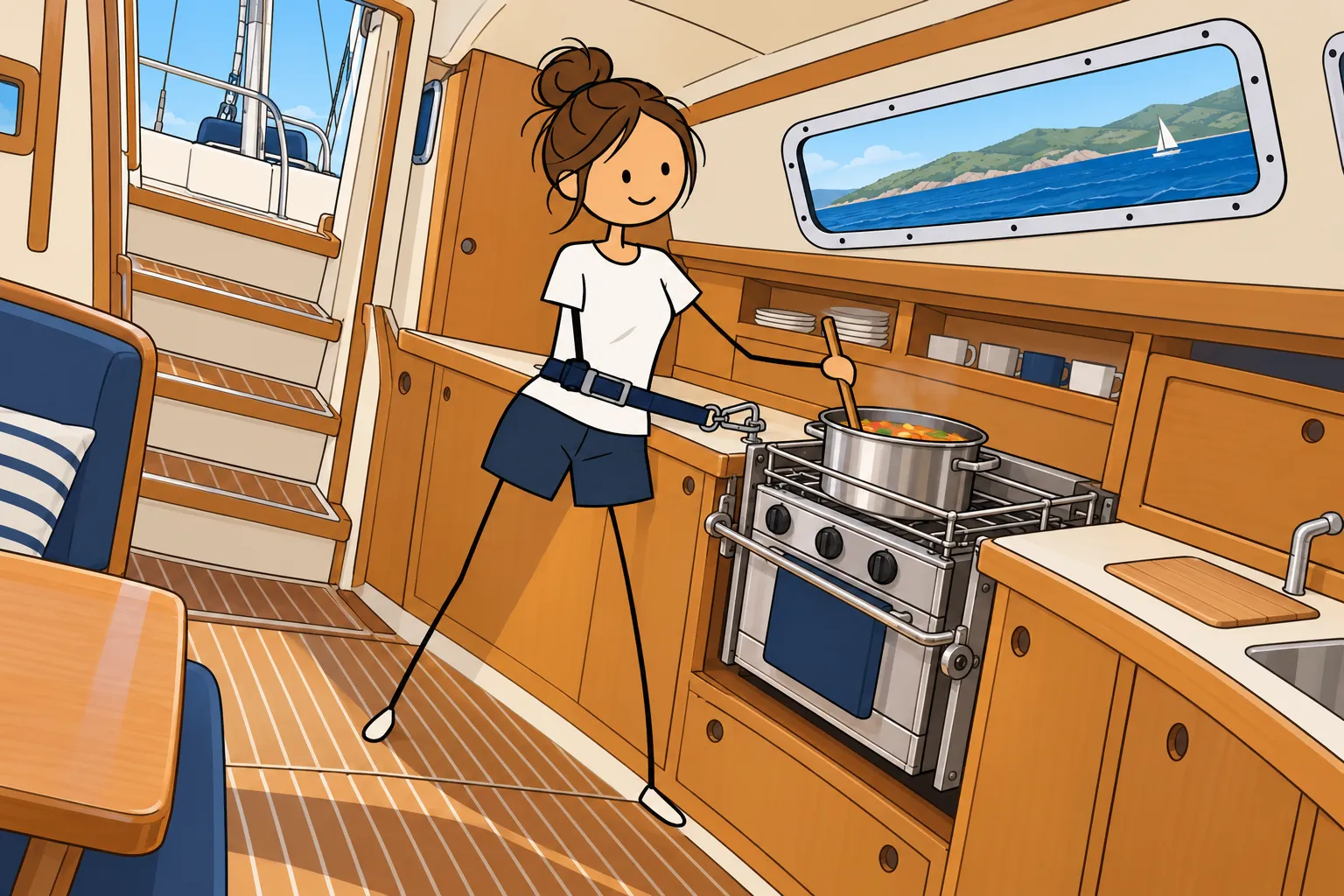
You can, but it's easiest when the boat is still. Breakfast is on board or in the marina, lunch after a swim at anchor, and dinner at a restaurant on the island or on board, so cooking mostly happens at anchor or in harbour.
Under way it's different, especially on a sailboat, which heels under sail. That's why the stove on many sailboats is gimballed: when the boat heels the stove stays level, so the pot doesn't slide. There are rails and holders around the burners, and a metal bar in front of the stove keeps the cook away from the hot surface. When the boat is still, the stove is usually locked in place.
Even so, the galley is where most injuries on a boat happen, including scalds from spilled hot liquid. If you cook under way:
- fill pots no more than half and fix them with the holders
- never leave a lit stove unattended
- tell the skipper before you light it
- pass hot mugs hand to hand to the cockpit instead of carrying them up the steps
Simplest is to make sandwiches or a salad before casting off and leave cooking for the anchorage. A catamaran sails flat, so it's easier there, but the same rules apply.
What's easy to cook on a boat?
The best boat dishes have few ingredients and one pot.
One-pot dishes
- Tuna pasta: cook the pasta, drain it, then add tinned tomatoes, tuna, olives and capers to the same pot.
- Risotto with vegetables, mushrooms or seafood.
- Oven potatoes and vegetables, for dinners at anchor when it cools down.
What keeps well without a fridge?
Fridge space is never enough, so it helps to know what can sit in a locker: potatoes, onions, garlic, carrots, cabbage, lemons and apples, then pasta, rice, lentils and chickpeas, tinned tuna, sardines and beans, nuts, honey and crackers. Buy bread and fresh fruit on the way, from bakeries and markets on the islands.
Frequently asked questions
1Does every boat have an oven?
2Does the skipper cook?
3Do I need to bring anything for the kitchen?
4Does the fridge work at anchor?
5Is it safe to cook with gas on a boat?
Your week
Ready for your first dinner at anchor?
A boat galley is small, but it has everything for breakfast in the cockpit and dinner in a calm cove. Tell us how many of you there are and when you'd like to sail, and we'll suggest boats that suit you.