Greece sea temperature - 1.7 °C warmer in summer than in the 1980s
The sea around Greece is 1.7 °C warmer in summer than in 1982-1991. NOAA data for 7 areas from 1982 to 2026: Halkidiki, Corfu, Lefkada, Sporades and more.

The sea around Greece is now on average 1.7 °C warmer in July and August than it was forty years ago. LUFF Yachting compared NOAA satellite measurements for 7 popular holiday and sailing areas, from 1982 to October 2026, and found that the summer average rose from 24.6 °C (1982-1991) to 26.3 °C (2016-2025).
We spend our summers on the water, so we wanted to know how much the sea has really changed. We picked areas you probably know if you holiday in Greece or are planning sailing in Greece: Halkidiki, the Olympic Riviera, Thassos, Corfu, Lefkada, the Sporades and the Saronic Gulf.
Key findings
- In July and August 2016-2025 the sea around Greece averaged 26.3 °C, 1.7 °C warmer than in 1982-1991, according to a LUFF Yachting analysis of NOAA data for 7 holiday areas.
- From 2016 to 2025 the sea around Greece was 26 °C or warmer on 46 days a year on average, compared with 4 days a year from 1982 to 1991 (average of 7 holiday areas).
- Summer 2026 was the second warmest since 1982: the sea around Greece averaged 27.0 °C in July and August, beaten only by 2024 (27.3 °C).
- Of the 10 warmest summers on the sea around Greece from 1982 to 2026, 9 were in 2012 or later.
- In the week from 25 September 2027 the sea around Greece averages 24.4 °C, as at the end of June, while a boat from the LUFF catalogue costs 35% less than in the most expensive week of the season (only 17% less in the week from 19 June).
How much warmer is the sea in Greece than in the 1980s?
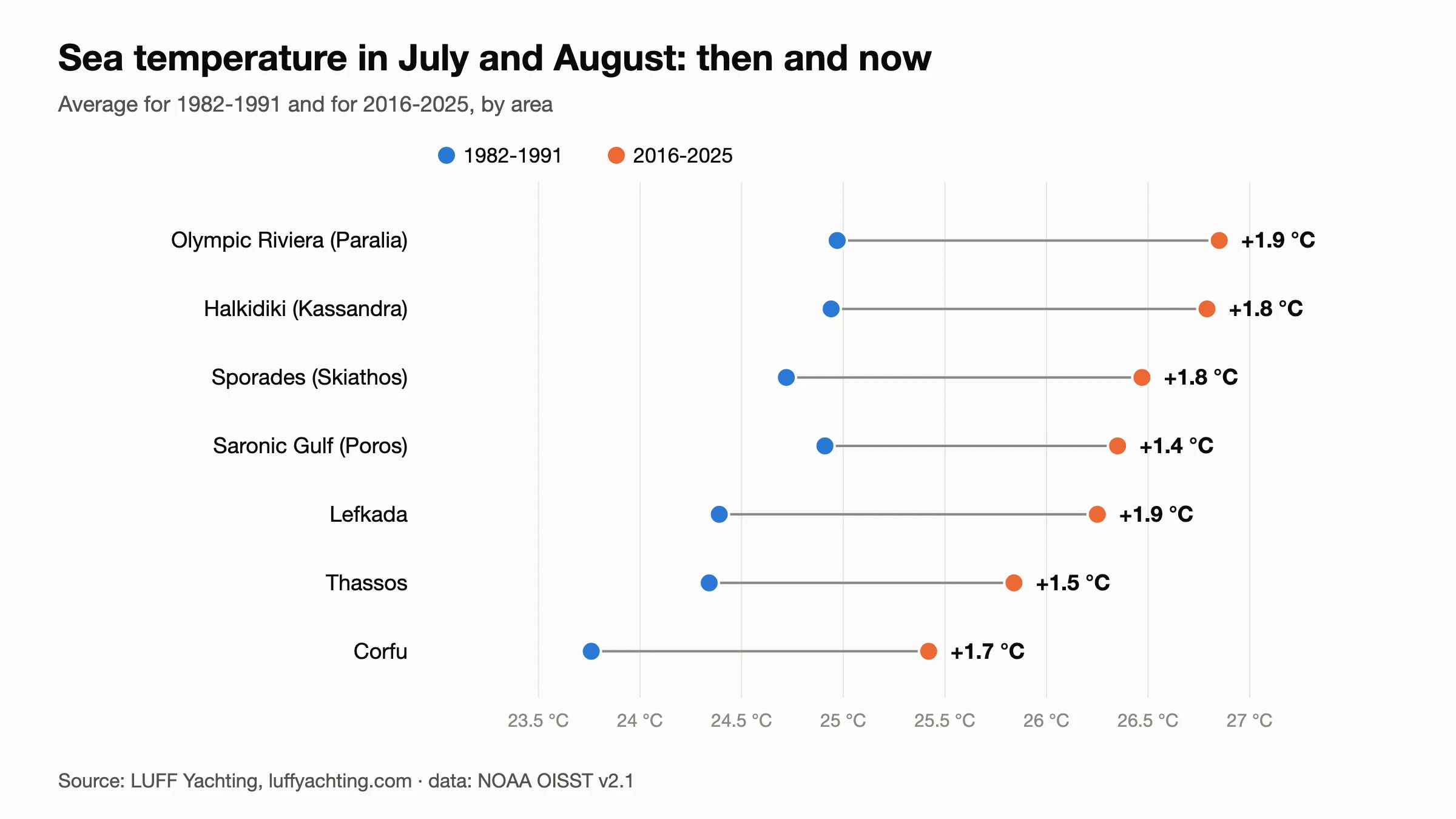
In all 7 areas the July-August sea is 1.4 to 1.9 °C warmer. It rose most on the Olympic Riviera, around Lefkada and in Halkidiki (1.9 °C each), and least in the Saronic Gulf (1.4 °C) and around Thassos (1.5 °C). On average that is about half a degree per decade (0.51 °C).
- Olympic Riviera (Paralia): July-August 1982-1991: 25.0 °C; July-August 2016-2025: 26.9 °C; change: +1.9 °C; summer 2026: 27.4 °C; days ≥ 26 °C a year (1982-1991 → 2016-2025): 9 → 62
- Lefkada: July-August 1982-1991: 24.4 °C; July-August 2016-2025: 26.2 °C; change: +1.9 °C; summer 2026: 27.3 °C; days ≥ 26 °C a year (1982-1991 → 2016-2025): 6 → 49
- Halkidiki (Kassandra): July-August 1982-1991: 24.9 °C; July-August 2016-2025: 26.8 °C; change: +1.9 °C; summer 2026: 27.4 °C; days ≥ 26 °C a year (1982-1991 → 2016-2025): 6 → 56
- Sporades (Skiathos): July-August 1982-1991: 24.7 °C; July-August 2016-2025: 26.5 °C; change: +1.8 °C; summer 2026: 26.9 °C; days ≥ 26 °C a year (1982-1991 → 2016-2025): 4 → 50
- Corfu: July-August 1982-1991: 23.8 °C; July-August 2016-2025: 25.4 °C; change: +1.7 °C; summer 2026: 27.2 °C; days ≥ 26 °C a year (1982-1991 → 2016-2025): 1 → 29
- Thassos: July-August 1982-1991: 24.3 °C; July-August 2016-2025: 25.8 °C; change: +1.5 °C; summer 2026: 26.2 °C; days ≥ 26 °C a year (1982-1991 → 2016-2025): 1 → 29
- Saronic Gulf (Poros): July-August 1982-1991: 24.9 °C; July-August 2016-2025: 26.4 °C; change: +1.4 °C; summer 2026: 26.7 °C; days ≥ 26 °C a year (1982-1991 → 2016-2025): 5 → 50
- Average of the 7 points: July-August 1982-1991: 24.6 °C; July-August 2016-2025: 26.3 °C; change: +1.7 °C; summer 2026: 27.0 °C; days ≥ 26 °C a year (1982-1991 → 2016-2025): 4 → 46
Changes are calculated before rounding, so a few differ by 0.1 °C from the difference of the rounded values.
Was summer 2026 the warmest on record?
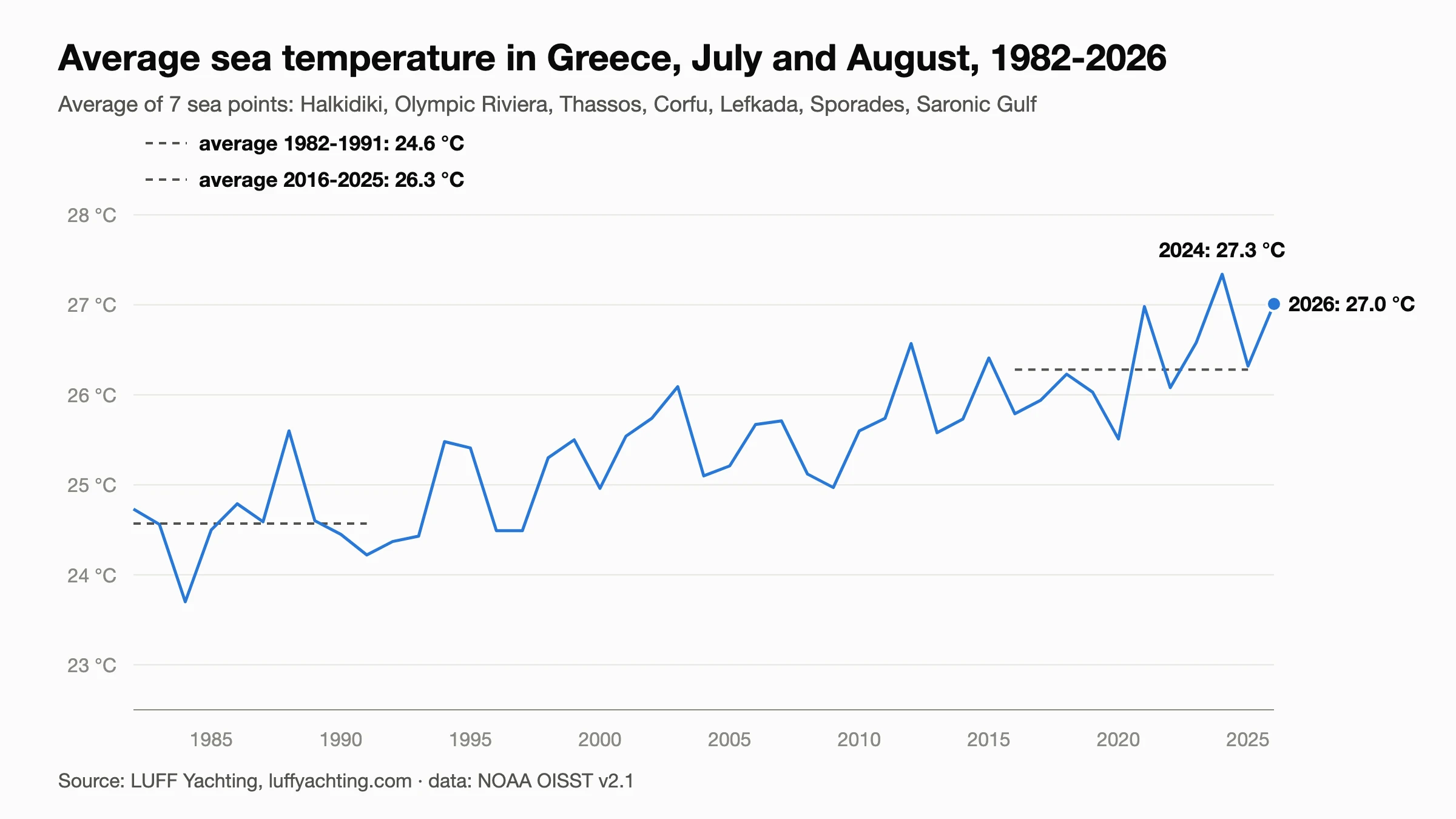
No, but it came close. In July and August 2026 the sea averaged 27.0 °C, the second warmest summer since 1982. Only summer 2024 was warmer, at 27.3 °C, and 2021 was almost exactly level with 2026. Corfu stood out: 27.2 °C in summer 2026, against an average of 25.4 °C for 2016-2025.
The run of years matters more than one summer. Of the 10 warmest summers in 45 years of measurements, 9 came in 2012 or later. The coolest were 1984, 1991 and 1992.
How many days a year is the sea 26 °C or warmer?
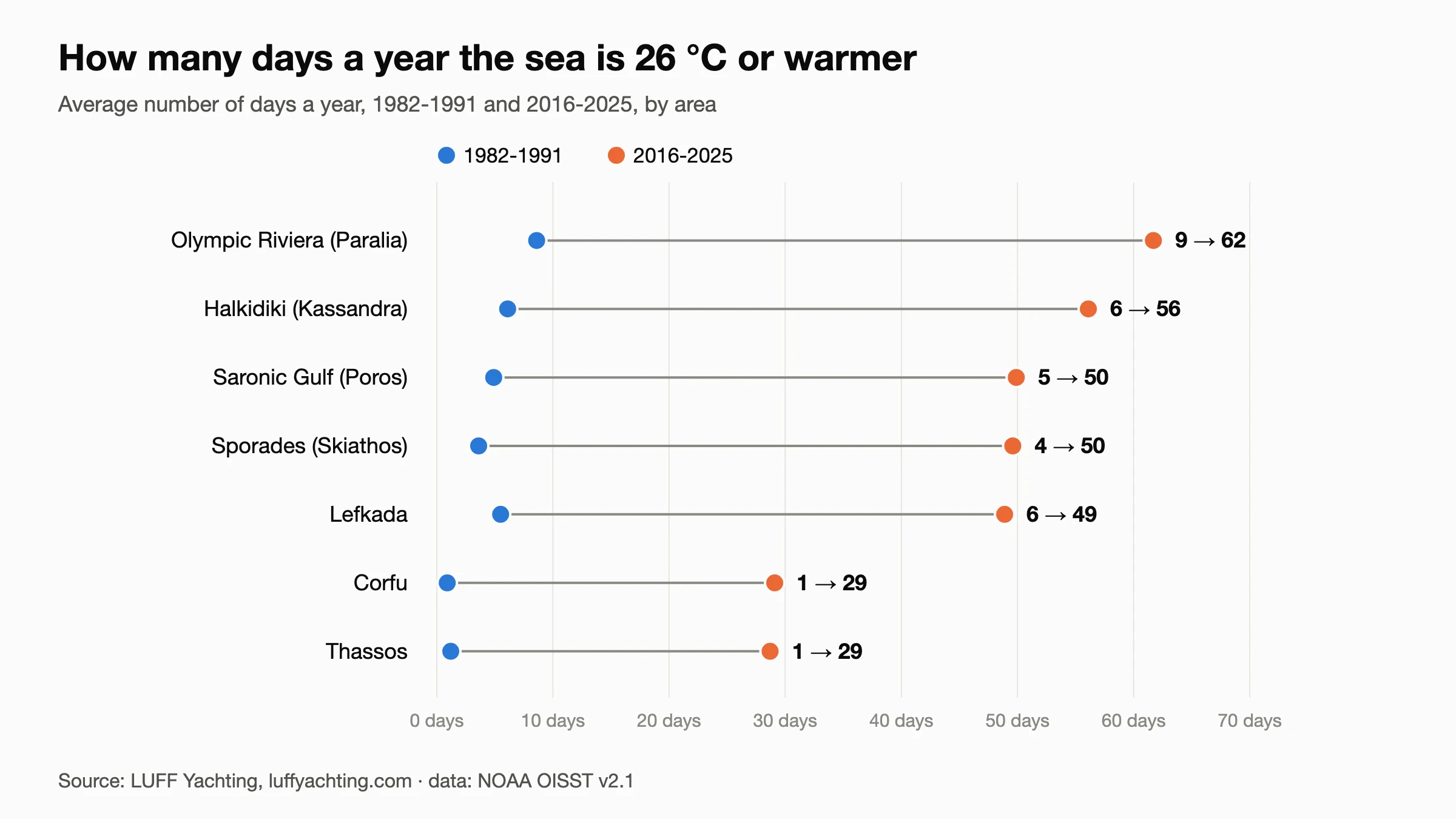
This is where the change shows most. In 1982-1991 the sea was 26 °C or warmer on 4 days a year on average. In 2016-2025 it was 46 days a year, about a month and a half of warm sea every summer.
On the Olympic Riviera these days went from 9 to 62 a year, in Halkidiki from 6 to 56. Around Corfu and Thassos, where the sea is cooler, from 1 to 29.
When is the sea in Greece warmest: June, July, August or September?
August is still the warmest month, but every summer month has shifted up. September now has a warmer sea (25.2 °C) than August had in the 1980s (24.9 °C). June is warmer too, 23.2 °C instead of 21.7 °C.
- June: 1982-1991: 21.7 °C; 2016-2025: 23.2 °C; change: +1.6 °C
- July: 1982-1991: 24.2 °C; 2016-2025: 25.9 °C; change: +1.8 °C
- August: 1982-1991: 24.9 °C; 2016-2025: 26.6 °C; change: +1.7 °C
- September: 1982-1991: 23.8 °C; 2016-2025: 25.2 °C; change: +1.4 °C
The warm-sea season is longer as well. The sea is now 22 °C or warmer on 135 days a year on average, against 113 in 1982-1991.
When do you get the warmest sea for the price?
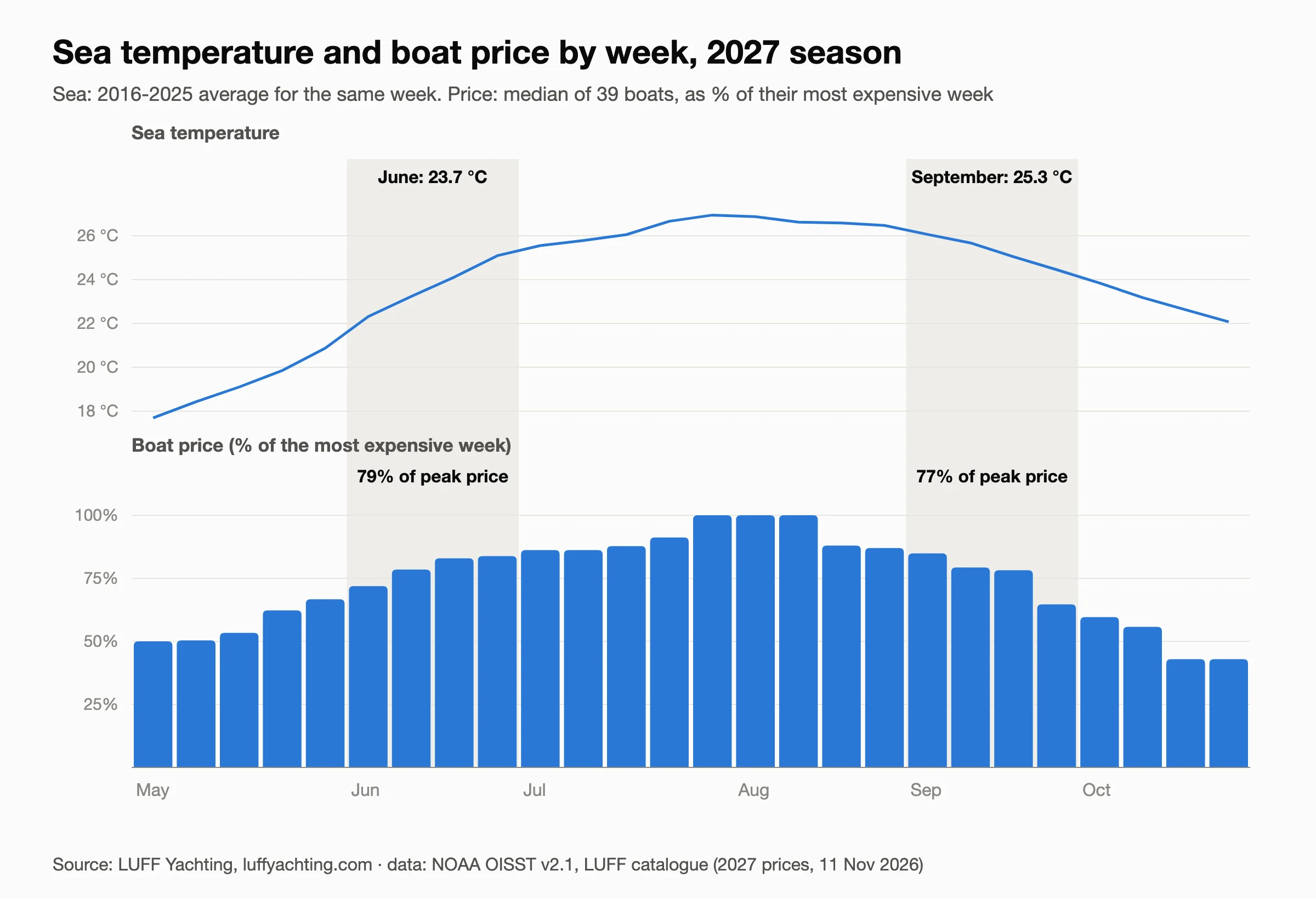
We set the sea temperature against the prices of boats in our catalogue for the 2027 season. We took 39 boats from three bases (Lefkada and Preveza, Athens, Volos) and, for every week from May to October, worked out how much cheaper each boat is than in its own most expensive week. The sea temperature is the 2016-2025 average for the same week, off those three bases.
The three weeks from 31 July to 21 August are the most expensive, and the sea is at its warmest then too, 26.6 to 26.9 °C. The median boat price in those weeks is €6,890 a week.
September beats June. The sea averages 25.3 °C in September and 23.7 °C in June, while a boat costs 77% of its peak-week price in September and 79% in June. A warmer sea for a slightly lower price.
The gap is widest at the end of September. In the week from 25 September 2027 the sea around Greece averages 24.4 °C, as at the end of June, while a boat from the LUFF catalogue costs 35% less than in the most expensive week of the season (only 17% less in the week from 19 June).
- May: sea (2016-2025 average): 19.2 °C; boat price, % of the most expensive week: 57%
- June: sea (2016-2025 average): 23.7 °C; boat price, % of the most expensive week: 79%
- July: sea (2016-2025 average): 26.2 °C; boat price, % of the most expensive week: 90%
- August: sea (2016-2025 average): 26.6 °C; boat price, % of the most expensive week: 94%
- September: sea (2016-2025 average): 25.3 °C; boat price, % of the most expensive week: 77%
- October: sea (2016-2025 average): 22.9 °C; boat price, % of the most expensive week: 50%
A month is the weeks that start in it (the week from 31 July counts as July).
What does this mean for a sailing week?
June and September are no longer the "cold" ends of the season. The sea in September is now warmer than it used to be in mid-August, and the crowds and prices are usually lower than in July and August. If swimming matters most and you don't love the heat, these are good months for a sailing week.
In July and August the sea is warmer than ever, and so is the air. On a boat you can swim whenever you like, off the stern or in a quiet bay, and that is the best way to cool down. Bring a hat, sun cream and plenty of water.
The differences between areas matter when you pick a route. The Ionian Sea around Lefkada is calmer and has short legs, which makes sailing the Ionian Sea a good first choice. In July and August the meltemi blows across the Aegean, including the Sporades, and the skipper proposes the route and puts it together around the weather and the guests' wishes.
Methodology
- Source: NOAA OISST v2.1 (Optimum Interpolation Sea Surface Temperature), daily sea surface temperature from satellites, ships and buoys on a 0.25° grid (about 25 km). Monthly means come from the NOAA PSL server, daily values from the NOAA CoastWatch ERDDAP server.
- Points: 7 sea cells of the grid, one per area: Halkidiki, Kassandra (40.125° N, 23.625° E), Olympic Riviera, Paralia (40.375° N, 22.625° E), Thassos (40.375° N, 24.625° E), Corfu (39.625° N, 19.625° E), Lefkada (38.625° N, 20.375° E), Sporades, Skiathos (39.125° N, 23.625° E), Saronic Gulf, Poros (37.625° N, 23.375° E).
- Period: January 1982 to October 2026. We compare the first and the last 10 full years: 1982-1991 and 2016-2025.
- Calculation: the summer average is the mean of the July and August monthly means. "Average of the 7 points" is the mean of all 7 areas. The trend is a linear regression of the summer averages 1982-2025. Days at 26 °C or warmer are counted from the daily values, per area and year, then averaged. Changes are calculated before rounding.
- Left out: we measure the open sea off the coast, not shallow water and bays, which can be warmer in summer. Satellites measure only the surface. Daily data for 1992-1998 are incomplete, so they are not used for day counts (averages and the trend use the monthly data, which are complete). In the compared periods 17 days per area are missing: a single missing day takes the mean of its neighbours, and days from December to April take that month's mean, far below 22 °C.
- Boat prices: the LUFF catalogue, the same prices as on the boat pages of our site (live from Booking Manager). We took 42 boats, 14 from each base (Lefkada and Preveza, Athens, Volos), half sailboats and half catamarans. We count the 39 boats that have a price for all 26 weeks, from 1 May to 30 October 2027. It is the price a guest pays today, with the First Minute discount, for the boat only (skipper, fuel, marinas and food are extra). Discounts change as the season fills. Each week's price is divided by the same boat's most expensive week, and the weekly figure is the median of all boats, so large catamarans don't move the result. The sea temperature for those weeks is the average of the daily values for the same 7 days in 2016-2025, at the points off the bases (Lefkada, Poros, Skiathos). These are our catalogue's prices, not the whole market.
- Data as of: sea temperature 9 November 2026, boat prices 11 November 2026.
How to cite this data
Source: LUFF Yachting, "Greece sea temperature - 1.7 °C warmer in summer than in the 1980s", November 2026, https://luffyachting.com/blog/greece-sea-temperature
You may use the numbers and the charts in your articles with this credit and a link to this page. For the full dataset, a chart in another format, or a short comment from us, get in touch.
Sources
- https://www.ncei.noaa.gov/products/optimum-interpolation-sst (NOAA OISST v2.1, dataset description)
- https://psl.noaa.gov/data/gridded/data.noaa.oisst.v2.highres.html (monthly means, NOAA PSL)
- https://coastwatch.pfeg.noaa.gov/erddap/griddap/ncdcOisst21Agg.html (daily values, NOAA CoastWatch ERDDAP)
- https://luffyachting.com/catalog (LUFF catalogue, 2027 season prices pulled on 11 November 2026)
Frequently asked questions
1What is the sea temperature in Greece in August?
2Where is the sea warmest in Greece in summer?
3Is the sea in Greece warmer than it used to be?
4When is sailing in Greece the best value?
5Is the sea in Greece warm in September?
Your week
Swim off the boat whenever you like
If you want a week where the sea is always one step away, tell us your dates and group size and we will suggest boats and routes. Send us an inquiry and head for warm water.